Client books fall apart before the close.
They shouldn’t.
With traditional automation, work happens throughout the month, but the record still isn’t reliable enough to trust. Because it is still changing and not fully controlled, it cannot be meaningfully queried.
Auciera maintains the record continuously. Every change is captured and understood as it happens.
Full control across every client
Grounded in the record
THE REAL COST
By the time the record is reviewed, the damage is already done.
Your most experienced accountants are not reviewing clients. They are chasing missing context, clearing unresolved exceptions, and correcting issues that should have been addressed when they occurred.
Work happens throughout the month. Transactions are processed, categorized, and reviewed continuously. But the record is still not reliable enough to trust. Issues accumulate quietly. Adjustments happen later. The system reflects activity, not a controlled state.
If the record is not controlled, nothing built on top of it can be trusted.
WHAT CHANGES
Verification that doesn’t wait
Most systems still rely on staged workflows to validate the record. Transactions move through the system continuously, but categorization, reconciliation, and review still happen in steps. Exceptions accumulate. Confidence comes later. This is why those systems cannot be trusted while the record is still evolving. They are designed to correct, not to verify continuously.
Auciera is different. Transactions are categorized and reconciled as they occur. Issues are identified in the moment and resolved before they compound. The record is not cleaned up at the close. It is maintained throughout the period. This is what allows direct questions to return reliable answers, and defined activities to run on data that has already been verified. The close becomes a confirmation, not a reconstruction.
Most systems focus on speeding up the work. That is not where the problem sits.
“Automation isn’t the problem. Control is. If the record isn’t maintained as it evolves, nothing built on top of it can be trusted.”
This is the difference between processing activity and maintaining a reliable record. When the record is not controlled as it evolves, every answer built on top of it carries uncertainty.
If the record isn’t controlled, AI is just guessing.
BEFORE AND AFTER
The same close. A completely different experience.
The workload does not disappear. The timing of it changes. For a practice managing multiple client books, timing is everything.
“It’s the close. Something is off. We trace it back three weeks to an entry that should have been caught the day it was made. The senior accountant has been on this for two hours.”
- Issues surface when the record is finally reviewed, not when they occur
- Senior staff spend close week reconstructing, not reviewing
- The client advisory call gets pushed. The work that justifies your fees waits.
- The next close starts with the same uncertainty as this one
- Questions asked during the period cannot be trusted because the record is still changing and not fully controlled
“A flag came up three weeks ago. We dealt with it the same day. The close arrived and there was nothing to fix. We sent the client report early.”
- Issues are caught as they occur, not only when the record is reviewed later
- Senior staff review client positions, not reconstruct periods
- The close is a confirmation. Not the moment everything breaks.
- Each close is more predictable than the last
- Direct questions return reliable answers because the record is consistently maintained
When the record is controlled, questions stop being risky and start becoming useful.
INTERACTION
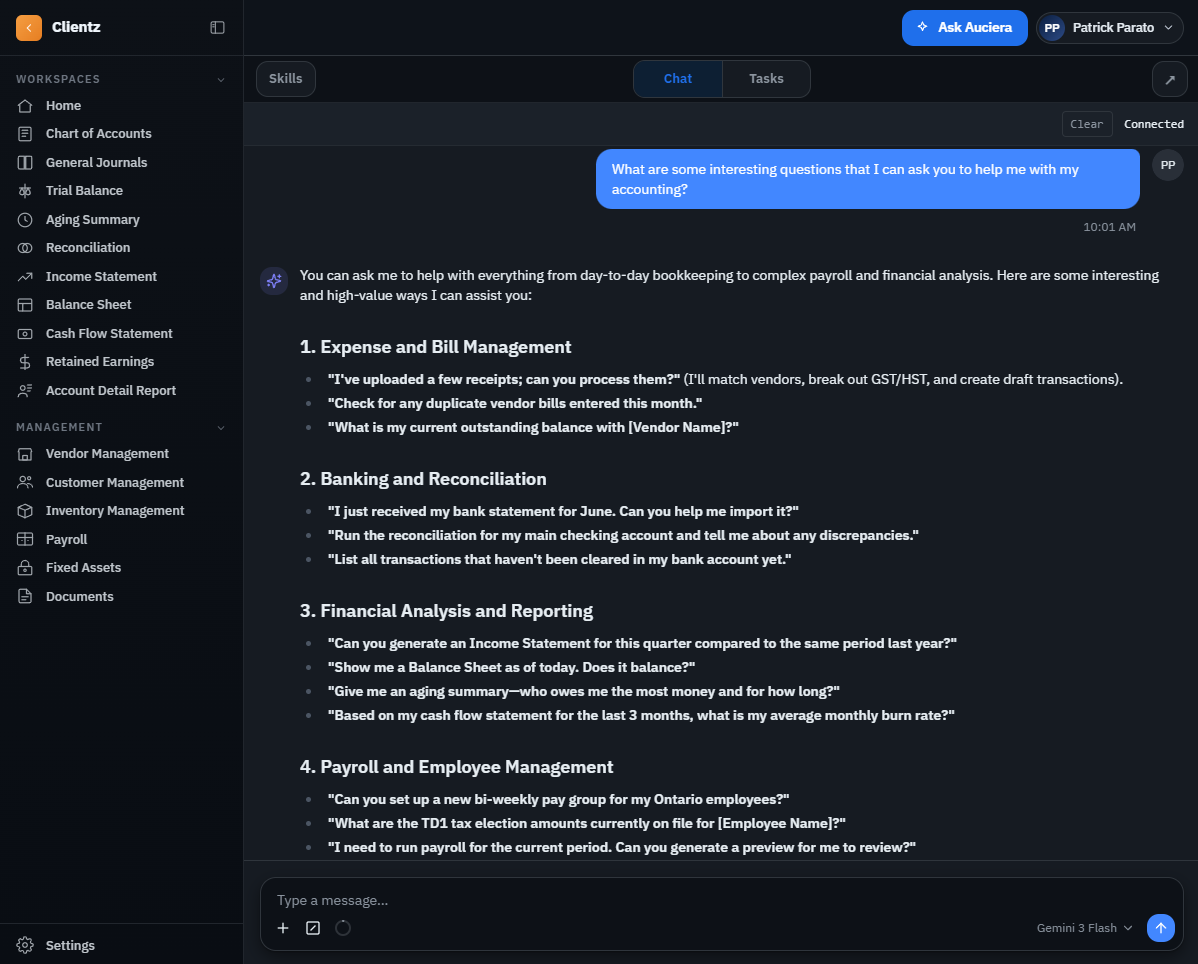
Ask a direct question. Get an answer you can act on.
Work directly against the record. Ask a question. Get a structured answer tied to categorized, reconciled data. No report building. No assumptions.
Because the record is continuously verified, questions return answers you can act on immediately.
Why these answers hold up
The answers are only as strong as the record behind them.
In most systems, answers require interpretation. Here, they are grounded in a controlled, continuously verified record.
Auciera does not generate responses from partial data or assembled reports. Every answer comes from a record that is maintained, verified, and fully traceable.
The output is only as reliable as the record behind it. That is what Auciera is built to maintain.
CLIENT FEEDBACK
What our customers in early access are telling us.
“The record ingestion and ongoing recording with Auciera was simple, significantly faster, and accurate. In fact, far less prone to human error…”
Monthly close tells you what happened. It does not give you a record you can use during the period.
If the books are only reliable at the end of the month, every question asked before that point is based on incomplete information. The output may look precise, but it cannot be trusted.
Auciera maintains the record continuously, so the system can be used at any point. You are not waiting for the close to trust the answer.
Automation executes predefined steps. It does not ensure the record is complete or correct when those steps run.
If the underlying books are inconsistent, automation simply processes bad data faster. The output may be efficient, but it is still unreliable.
Auciera is built around maintaining a consistent record first. That is what allows defined activities to run safely and produce results you can trust.
General AI tools operate outside the structure of the accounting record. They generate answers based on patterns, not on a verified, complete set of books.
If the data is incomplete or contains unresolved issues, the response may sound correct while being materially wrong.
Auciera operates within the record itself. The system is grounded in the underlying entries, and the record is maintained continuously. That is what makes the output dependable.
Yes. Judgment does not go away.
The difference is when it is applied. In traditional systems, judgment is concentrated at the end of the period, when issues have already accumulated and the record is unreliable during the period. In Auciera, judgment is applied as gaps appear. The record stays consistent as it evolves, which is what allows the system to be used continuously and the output to remain reliable.
The system identifies the gap immediately and requires resolution before it compounds.
In traditional systems, issues can sit unresolved while the rest of the work continues. That creates a record that looks complete but cannot be trusted.
Auciera prevents that state from forming. The record is either consistent or it is flagged and addressed. That is what protects the integrity of every answer and every activity.
Only if the underlying record is complete.
In most systems, the answer depends on data that is still being reconciled. That makes the result partial or misleading, even if it appears precise.
Because Auciera maintains the record continuously, answers are based on a consistent set of books. That is what makes them reliable when you need them, not just after the close.
Because activity is not the same as control. Transactions may be processed continuously, but without continuous verification, the record can still change in ways that are not fully understood. That is what prevents it from being relied on in real time.
Because they are based on records that are still evolving. Even if the output looks precise, it may reflect unresolved issues or incomplete reconciliation. The result is something that must be interpreted, not relied on.
This is how your
firm should operate.
If you want your firm to operate this way, let’s talk. A 20-minute conversation. No deck. No demo. No preparation required. You’ll know quickly if it fits.
Start a ConversationNo obligation · No junior rep