

Bolt-On AI vs Native AI in Accounting: Why the Difference Matters for Business Owners
In this article, we explain the difference between bolt-on AI and native AI in accounting software, why this distinction matters for business owners, and how it impacts accuracy, trust, and financial decision-making.
Artificial intelligence is rapidly transforming the accounting industry. Nearly every modern accounting platform now claims to use AI in some form, promising automation, efficiency, and better financial insight.
However, not all AI-powered accounting systems are built the same way.
There is a critical difference between bolt-on AI and native AI, and that difference directly affects accuracy, reliability, and trust. For business owners and accounting professionals, understanding this distinction is essential when choosing an accounting platform that can scale with the business.
Professional Accounting Systems vs AI Tools
Most accounting software in use today was designed long before artificial intelligence became practical. These platforms were originally built to manage core functions such as the general ledger, accounts payable, accounts receivable, and financial reporting.
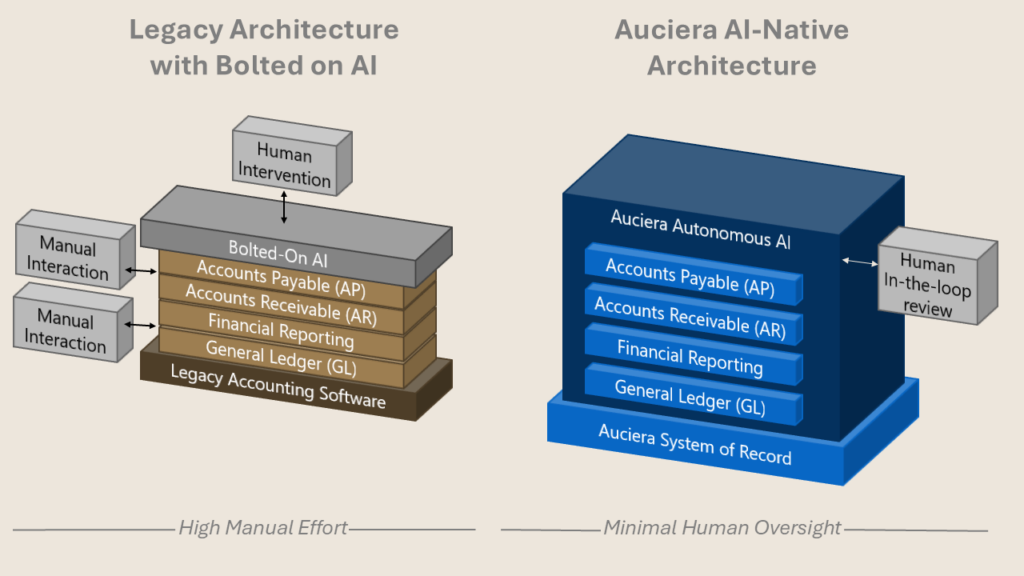
When AI became popular, it was added on top of these systems rather than built into them. This is known as bolt-on AI.
Bolt-on AI typically works by analyzing data after it has already been entered into the system. It may suggest categories, automate data entry, or highlight anomalies, but it does not truly understand the structure or intent of the accounting data. The intelligence exists outside the system rather than within it.
Native AI accounting platforms take a different approach. Instead of layering AI on top of legacy software, intelligence is built directly into the foundation of the system. The accounting engine itself is designed to work alongside AI, allowing it to reason about transactions, validate data in real time, and maintain consistency across all financial processes.
This architectural difference becomes increasingly important as businesses grow and financial complexity increases.
AI Is Easy. Responsibility Is Hard.
Artificial intelligence is becoming easier to build and deploy. Responsibility, however, is not.
In accounting, responsibility cannot be automated away. Business owners, finance teams, and accountants remain accountable for the accuracy of financial records and reports. Errors can lead to compliance issues, tax problems, or poor business decisions.
Bolt-on AI systems often assume that users will catch mistakes. They rely on manual review to identify problems after the fact. As automation increases, this creates risk because users naturally begin to trust the system more, even when the system lacks proper safeguards.
Native AI systems are designed with accountability in mind. They evaluate transactions in context, identify inconsistencies, and flag issues before they become problems. Human review is not removed but instead placed where it adds the most value.
This approach aligns far better with real-world accounting practices and regulatory expectations.
Bolt-On AI Assumes Trust. Native AI Produces Trust.
One of the most important differences between bolt-on AI and native AI is how trust is established.
Bolt-on AI assumes the data is correct and that the surrounding workflows are reliable. When something goes wrong, the burden falls on the user to detect and correct it.
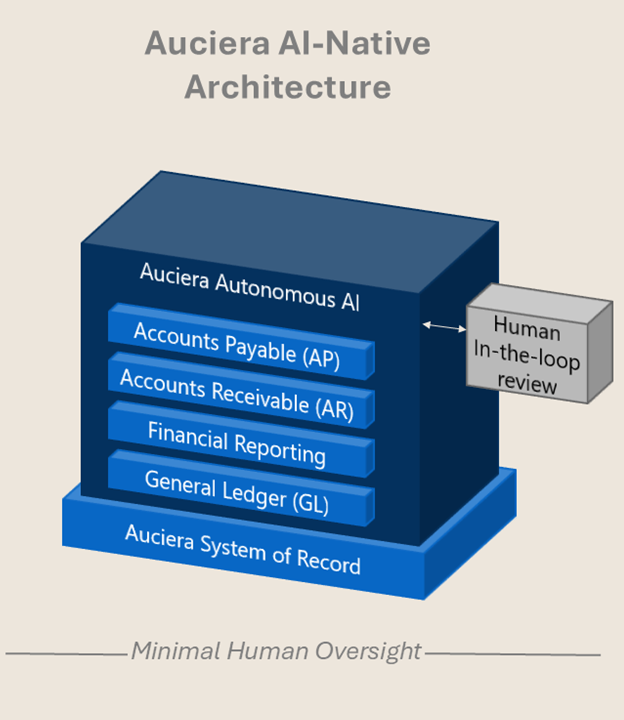
Native AI is designed to produce trust rather than assume it. Because intelligence is embedded directly into the accounting system, it can validate transactions as they occur, apply consistent logic, and surface issues early.
This creates a more transparent and auditable environment, which is critical for financial reporting, compliance, and decision-making. Trust is not an afterthought. It is built into the system itself.
Why This Matters for Business Owners
Most business owners are not interested in the technical details of AI architecture. What they care about is whether they can rely on their numbers.
They want to know if their financial reports are accurate, if their books are clean, and if they can confidently make decisions based on the data they see. They also want assurance that their accounting system will scale as their business grows.
Bolt-on AI can improve efficiency, but it often introduces hidden complexity. When something breaks, it can be difficult to trace the issue or understand how a conclusion was reached.
Native AI reduces this risk by unifying data, logic, and validation in a single system. The result is cleaner financials, fewer surprises, and greater confidence in decision-making.
How Auciera Approaches AI Differently
Auciera was designed from the ground up as a native AI accounting platform. AI is not an add-on or an afterthought. It is embedded directly into the system of record.
The general ledger, accounts payable, accounts receivable, and financial reporting all operate within a unified AI-driven architecture. This allows Auciera to continuously validate data, identify anomalies, and support human review without disrupting workflows.
Rather than replacing accountants or finance teams, Auciera enhances their work by providing better visibility, stronger controls, and more reliable data.
This approach makes Auciera particularly well suited for growing businesses that need accuracy, transparency, and scalability without increasing manual effort.
Final Thoughts
AI is transforming accounting, but how it is implemented matters just as much as whether it is used at all.
Bolt-on AI can help teams move faster, but it often assumes trust instead of creating it. Native AI is designed to produce trust through structure, validation, and transparency.
For business owners and accountants who care about accuracy, compliance, and long-term scalability, this distinction is critical. It is the difference between adding intelligence to a system and building intelligence into the foundation. And it is the difference Auciera was built to deliver.
About the Author

Patrick Parato is the Head of Growth at Auciera, an AI-native accounting platform built to bring clarity, accuracy, and trust to financial operations. He holds a degree in Computer Science and has spent his career working at the intersection of technology, data, and business systems.
At Auciera, Patrick helps shape product strategy, platform positioning, and market education, with a particular focus on AI-native system design, financial transparency, and scalable growth. He regularly writes about the role of AI in accounting, the importance of trust in financial systems, and how modern technology can support better decision-making without sacrificing control or accountability.
With a strong technical background and deep experience in go-to-market strategy, Patrick focuses on how modern software architecture, automation, and AI can be applied responsibly in real-world business environments. His work centers on translating complex technical concepts into practical solutions that business owners and accounting professionals can actually rely on.
Related Articles
Interviews with Accounting and Finance Leaders
Conversations with professionals on how AI, automation, and modern systems are changing accounting workflows.
-
Autonomous AI in FP&A: Why Data Governance Determines Trust
Autonomous AI Can Build the Forecast, But Only If Your Data Can Survive the Audit An interview on why data governance, auditability, and human accountability determine whether autonomous FP&A actually works. The tension in 2026: CFOs want speed and demand control By 2026, Artificial Intelligence (“AI”) is no longer a “future” topic in finance. Gartner…
-
Will AI replace CPAs and Accountants?
AI is being embedded in CPA services, it’s not just “drafting memos”. These AI solutions will reshape the way CPAs work. In an effort to better understand this change, Auciera had a conversation with a CPA professional, Dan Carli, CPA, CMA, MBA.
How Auciera Approaches AI-Native Accounting
Learn how Auciera’s platform is designed from the ground up to support accuracy, automation, and trust.