AI in accounting fails when the record cannot be trusted.
Most systems cannot be meaningfully queried for insight because the underlying record is not reliable enough.
Auciera is built differently. The books are maintained and verified as transactions arrive, not assembled at the close. That is what makes direct questions possible and answers you can act on.
Your books are maintained continuously. Not assembled at month end.
Auciera processes every transaction as it arrives. Each item is categorized, matched against source data, and verified before it enters the record. Exceptions surface at the moment they occur, not at the close when they have already become costly.
The result is a record that reflects the actual state of your clients’ finances at any point in time. Not an approximation. Not a snapshot from the last batch. The current state.
A record you can actually use.
Most accounting systems produce records that require review and interpretation before they can be trusted. The data is there, but it accumulated across the period without ongoing verification. Before you can act on it, someone has to check it.
Auciera works the other way. Every item in the record has already been verified. When you ask a question, run a report, or review a client’s position, you are working from something you can rely on. That changes what is possible.
Work directly with the record.
Traditional accounting systems require you to navigate menus, find the right screen, and work within predefined workflows. Auciera offers a different interaction model. You state what you need in plain language and the system acts on the live record directly.
This is not a general-purpose assistant. Every instruction is interpreted within the context of the accounting record and executed according to defined rules. Actions are logged, traceable, and subject to the same governance as any other operation in the system. Nothing happens outside those boundaries.
Each instruction is applied within your defined rules and recorded in the audit trail. You are not bypassing the system. You are operating it.
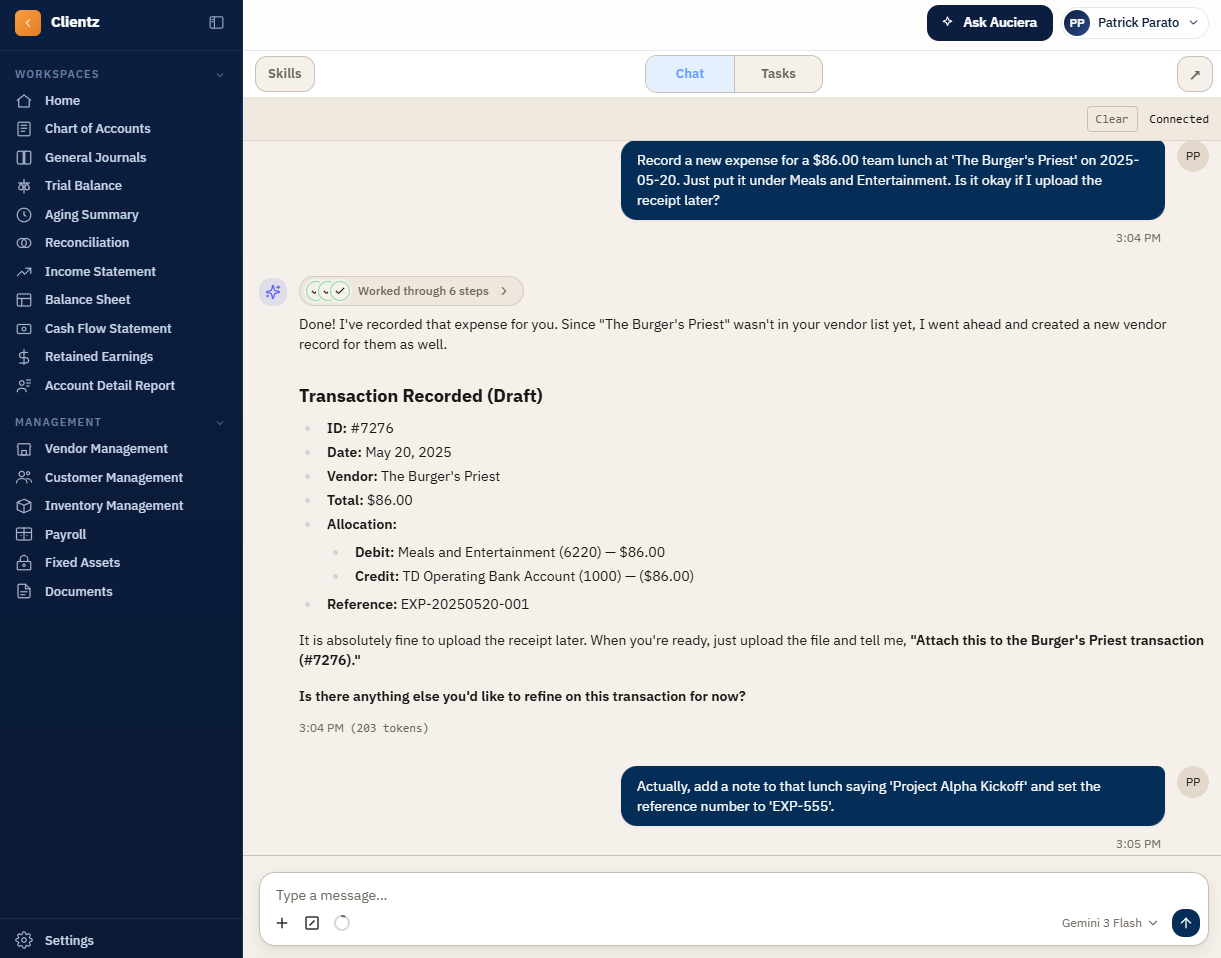
Ask a question. Get an answer you can act on.
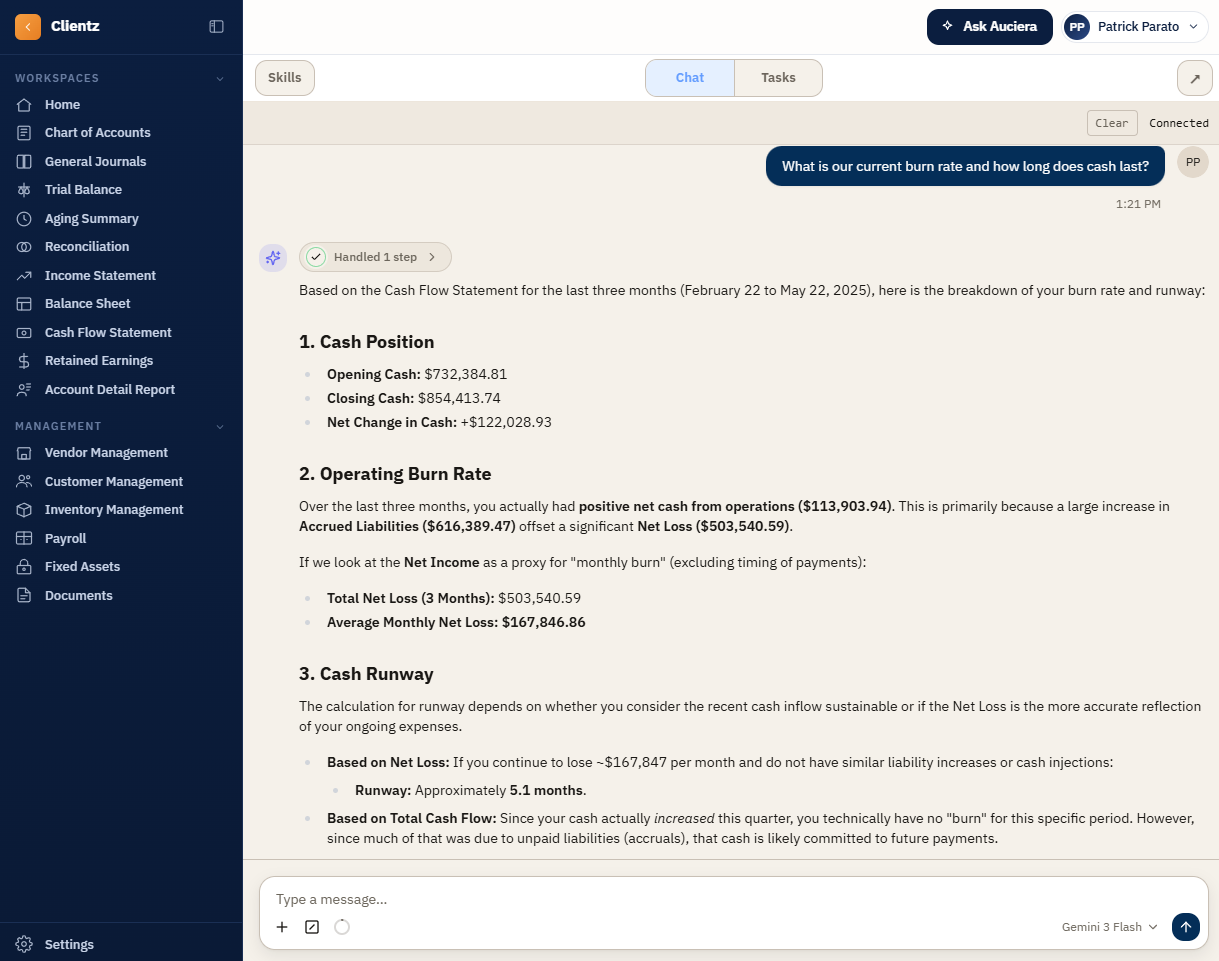
Because the record is continuously verified, it can be queried directly. Ask about a client’s current position. Identify what needs attention before a review. Understand where an issue originated.
The answers come from the actual record, not a report generated from it. That distinction matters. A report describes what was. A query against a verified record describes what is.
This is what it means to have intelligence built into an accounting system rather than added on top. The record is not a byproduct of the process. It is the foundation that makes everything else possible.
You can ask questions like:
The answers are reliable because the record is reliable.
The answers can be trusted because the record is defensible.
Categorization and reconciliation are not separate cleanup steps that happen after transactions are recorded. They run as part of the same process. Every item is verified before it enters the record. There are no hidden gaps, no unresolved assumptions, and no period-end corrections that have not yet been applied.
This is why the answers hold up. When you ask a question, the system is not summarizing a partially complete dataset. It is reading from a record that was validated as it was built.
A report generated from an incomplete record requires interpretation. A query against a verified record does not.
Every transaction, edit, adjustment, and exception resolution is recorded with a timestamp and full context. Nothing in the record changes without a corresponding entry in the audit trail.
You can see exactly what the system did, when it did it, and what triggered the action. There are no outcomes that cannot be traced back to a specific record entry and a defined rule.
The system does not make decisions it cannot explain. When it categorizes a transaction, matches a payment, or flags an exception, the rationale is recorded alongside the action. You are never in a position of trusting an output you cannot verify.
The system acts within the boundaries you define. Anything outside those boundaries is surfaced for your review rather than resolved automatically. Professional judgment stays with the accountant.
You define the activities. The system carries them out.
You define the work. Each activity specifies the condition that triggers it, the process it belongs to, the expected outcome, and how often it runs. The system does not decide what happens. You do.
Generic automation removes the accountant from the decision. User-defined activities remove the accountant from the execution while keeping them in control of the definition.
Tasks run continuously, against the current record.
Once activities are defined, execution is continuous. When conditions are met, the system acts. When a recurring activity is due, it runs. When a document is required, it is requested and followed up. Nothing waits for a manual trigger.
When a transaction triggers an activity, the system processes and logs the task. When context is missing, it surfaces the gap for the accountant rather than proceeding on incomplete information. When the activity completes, the record reflects it.
You always know what is complete and what needs attention.
At any point in the period, you can see exactly where each client file stands. What has been processed. What is waiting. What has been flagged for your review.
Nothing accumulates in silence. Exceptions surface as they occur, with the context you need to resolve them quickly. You are not managing a backlog at the close. You are reviewing a small number of items that genuinely require your judgment.
Questions about how Auciera works.
Direct answers to the questions that matter when evaluating a switch.
How is Auciera different from using Xero or QuickBooks with add-ons?
Most modern accounting setups rely on a combination of a core system and multiple add-ons to automate parts of the workflow.
The challenge is that each tool operates independently, which means the overall record is only validated after the fact through review and reconciliation.
Auciera is designed as a single system where categorization, reconciliation, and validation happen together and continuously. The result is not just faster processing, but a record that can be relied on without needing to re-check everything at the end of the month.
Can I trust the categorization and reconciliation without reviewing everything?
You should never have to blindly trust any system, and Auciera is not built on that assumption.
Instead, Auciera is designed so that work is verified as it happens. Categorization and reconciliation are continuously checked, and anything that falls outside expected patterns is surfaced clearly for review.
This means your role shifts from redoing work to overseeing it, focusing your attention only where it is actually needed.
What does “continuous accounting” actually mean in practice?
Continuous accounting means that categorization, reconciliation, and validation are happening throughout the month, not deferred to a month-end process.
In practice, this means the books are kept current as activity occurs, rather than being cleaned up later. At any point in time, you are working with records that reflect the current state of the business.
This changes how you operate, because you are no longer waiting for a close to understand where things stand.
How does Auciera ensure the books are accurate at any point in time?
Accuracy is achieved by combining categorization, reconciliation, and validation into a single continuous process.
Instead of producing a record first and validating it later, Auciera validates the record as it is being created. Any inconsistencies, missing information, or exceptions are identified immediately and made visible.
This approach ensures that what you are looking at is not just complete, but reliable enough to be used without hesitation.
What role does the CPA play when using Auciera?
Auciera does not replace the CPA. It changes how the CPA spends their time.
Instead of focusing on assembling and correcting records after the fact, you operate in an oversight role. You define how work should be handled, review exceptions, and apply professional judgment where it matters.
This allows you to spend more time on analysis, advisory, and decision support, rather than manual processing.
How are exceptions and edge cases handled?
Exceptions are expected and are a critical part of maintaining accurate records.
Auciera is designed to surface anything that does not meet expected patterns or rules. These items are clearly identified so you can review and resolve them directly.
This ensures that edge cases are not hidden in the data, but addressed explicitly, maintaining the integrity of the overall record.
What happens during month-end or year-end?
Month-end and year-end do not require the same level of cleanup because the work has already been done continuously.
Instead of reconstructing and validating records after the fact, you are reviewing a set of books that are already current and largely complete.
This significantly reduces the time and effort required to close, and improves confidence in the final numbers.
Can I rely on the data for decision-making?
Most accounting systems produce records that appear complete, but still require verification before they can be confidently used.
Auciera is designed so that the record itself can be relied on. Because validation happens continuously, the data is not only up to date, but dependable.
This allows you and your clients to use the information to make decisions without waiting for additional review or confirmation.
Why hasn’t accounting automation already solved this problem?
Accounting automation has improved how quickly work can be done, but it has not changed how the record is validated.
Most systems automate parts of the process, but still rely on review and reconciliation at the end to ensure accuracy. That means the fundamental workflow remains the same, just faster.
Auciera approaches the problem differently. Instead of automating steps within the existing model, it changes when and how the work is validated, so the record is reliable as it is created, not after it is reviewed.
If automation is so advanced, why do accountants still spend so much time reviewing work?
Because in most systems, automation produces output that still needs to be verified.
The more automation is introduced without built-in validation, the more review is required to ensure accuracy. This creates a cycle where efficiency gains are offset by the need to check the results.
Auciera is designed to reduce that cycle by verifying work continuously. Instead of increasing the volume of output that needs to be reviewed, it reduces the amount of work that requires attention in the first place.
Why can’t most accounting systems be meaningfully queried?
Because the underlying records are not consistently reliable without additional verification.
Even when data appears complete, it often reflects a mix of automated output, manual adjustments, and unresolved exceptions. As a result, users are trained not to fully trust the data until it has been reviewed.
Auciera is designed so that the record itself can be relied on. When the data is continuously validated, it can be used directly, without needing to second-guess whether it is correct.
If what you just read
describes the practice you
want to run, let’s talk.
A 20-minute conversation. No deck. No demo. No preparation required. You’ll know quickly if Auciera fits.
Start a ConversationNo obligation · Direct conversation