Tag: AI in Accounting

  • The Death of Accounting Software

    The Death of Accounting Software

    The Death of Accounting Software

    How dynamic workflows will reshape accounting solutions

    For more than three decades, larger scale accounting software (i.e. ERP solutions) has been developed around a stable premise: the process is designed first, encoded in the application and then adopted by the user. The steps to customize the menus, approval paths, reports and exception rules differ subtly from one product to another, but the underlying model is consistent. The consultant configures the client workflows in the software, as best they can, and this establishes how users interact with software, while the organization modifies their processes to work with the software.

    For most small and mid-sized businesses, improving operational efficiency has traditionally meant selecting software with the closest approximation of their desired workflow and then layering additional automation tools around it. The objective has never been to create a workflow unique to the organization, but rather to configure and extend a predefined one. This architectural constraint has shaped enterprise software for decades and has become so commonplace that many organizations no longer question it.

    This model has been effective because accounting requires consistency: a general ledger must remain complete; transactions must be traceable; access must be controlled; and review must be documented. Standardized applications brought discipline to processes that had previously depended on paper files, individual memory and local practice. These applications also made it possible for organizations and accounting firms to serve more clients without rebuilding their systems for every engagement.

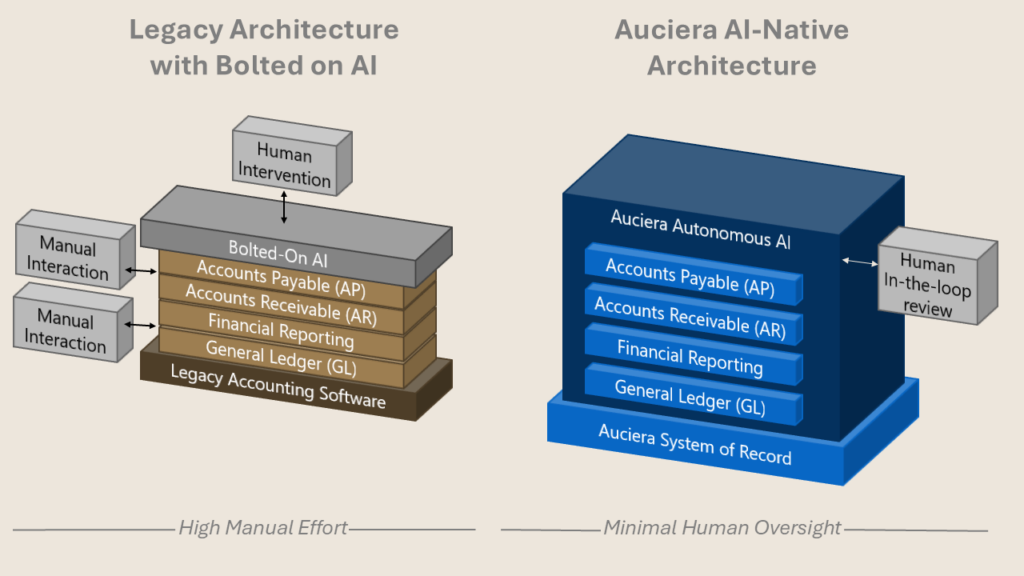
    The next evolution of these accounting solutions continues with this approach as they are unlikely to discard the foundational structure. Ledgers, controls, audit trails and reporting standards will remain essential. Rather than redesigning these applications from first principles, most software vendors are extending them by layering AI onto their existing architecture. AI assistants can answer questions, categorize transactions, summarize reports, draft communications and automate selected tasks, but they generally operate within workflows that were designed long before modern AI capabilities emerged. The underlying process remains largely unchanged. The limitation, however, is that AI remains subordinate to the workflow rather than defining it. It can accelerate individual tasks, provide recommendations and reduce manual effort, but it generally cannot reshape the process based on the circumstances of a particular client, engagement or organization. The workflow itself remains a product of software design rather than organizational knowledge.

    AI is beginning to make it possible for workflow to be assembled and adjusted around the circumstances of the work, rather than being fully prescribed in advance. This is where a fundamentally different architectural model begins to emerge. Rather than treating AI as another feature embedded within predefined workflows, dynamic workflow environments place AI at the orchestration layer. Instead of asking, “What is the next step in this process?” the system asks, “Given everything I know about this client, this organization, previous decisions, current priorities and available information, what should the next step be?” The workflow is no longer static; it evolves continuously as the system learns from human decisions, changing business conditions and accumulating organizational knowledge.

    That distinction is important as AI is currently treated as an additional feature within existing applications. A user can ask a question, summarize a report, draft a client message or receive a suggested account classification. These tools can be useful, but they leave the operating model largely unchanged and manually configured workflows by the implementation continue to take 2 to 6 months. The user still decides what must happen next, moves information between applications and steps, follows up on missing evidence and determines when an exception requires professional attention.

    A more consequential use of AI is emerging in systems that can interpret an objective, identify the steps required, use available tools, monitor the result and revise the sequence when circumstances change. The Associated Press has described the central difference between a conventional chatbot and an AI agent as the movement from producing an answer to taking action across a multistep task. A 2025 MIT Sloan Management Review and Boston Consulting Group study, cited by the AP, characterized these systems as capable of planning, acting and learning with greater independence than prompt-and-response tools.[1] The terminology remains unsettled, and some products described as agentic provide only limited autonomy. The underlying direction, however, is clear: software is being developed to participate in the execution of work rather than only presenting information to the person executing it.

    Microsoft has advanced a similar position. Reporting on Satya Nadella’s recent comments, the Financial Times noted his warning that organizations must develop and retain their own learning capabilities rather than allow the value created from their knowledge to accumulate entirely within external AI platforms.[2] His observations regarding learning systems suggest that enterprise advantage will depend on the interaction between human expertise, organizational data and systems that can learn from repeated use. In that model, the most valuable capability is not access to a general-purpose model. It is the ability to turn an organization’s experience into a continually improving and evolving operational system.

    This view is consistent with established research on process management. Thomas H. Davenport and Thomas C. Redman argued in Harvard Business Review that AI and process management should be developed together. Their position matters because isolated AI tools often improve individual activities without improving the end-to-end process in which those activities sit.[3] A faster classification, summary or response does not necessarily improve a workflow if information remains incomplete, responsibilities remain unclear or exceptions continue to circulate between people and systems. Process performance depends on the design of the whole sequence, including the points at which judgment, verification and escalation occur.

    This is where accounting provides a useful test. Accounting work is commonly described as a sequence of technical tasks: import transactions, classify them, obtain documents, reconcile accounts, prepare entries, review the file and issue a report. In practice, the difficulty lies in the context connecting those tasks. A transaction description may be incomplete, or the same vendor may represent different expenses for different clients, or a receipt may explain only part of a payment, or a recurring balance may be normal in one business and a warning sign in another. The accounting treatment may depend on information obtained in a meeting, an agreement stored elsewhere or a decision made during the prior year.

    Experienced accounting professionals manage this complexity by drawing on knowledge that is distributed across the firm. They remember how the client operates, which documents are usually late, which accounts are sensitive, which estimates require partner involvement and which explanations have previously been accepted. This knowledge determines the real workflow, even when the software displays the same screens for every client whether we are talking about a large business or the local business around the corner. The formal process may be standardized, but the workflows are continuously adapted by the people performing them.

    Dynamic workflows in accounting

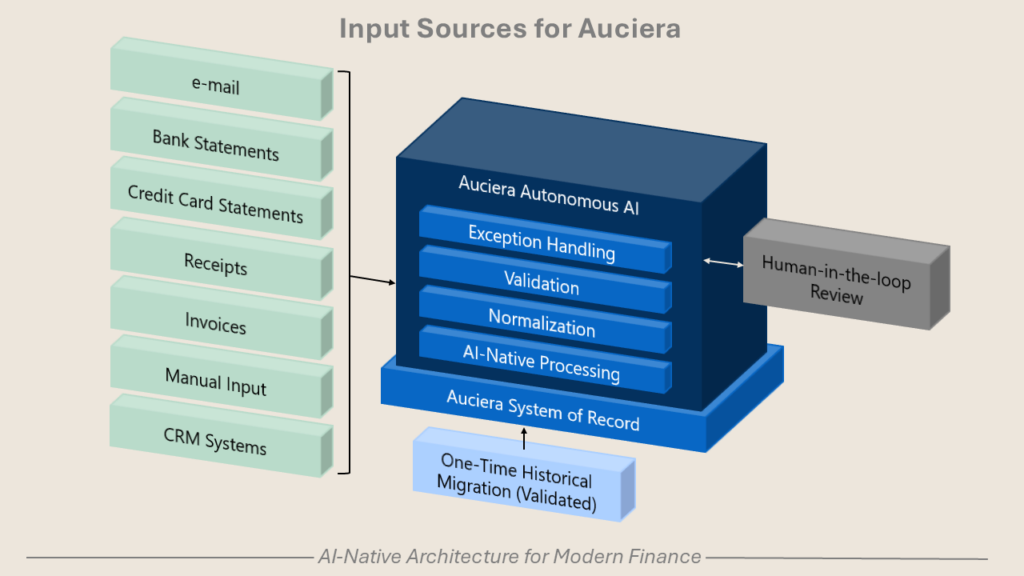
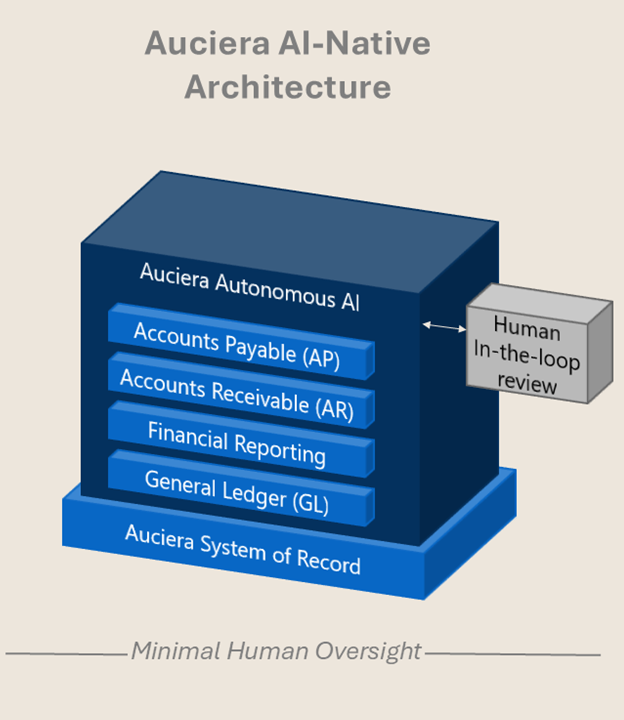
    An autonomous AI accounting solution would make more of that operating knowledge available to the system. It would not remove the ledger or weaken the control framework. It would use the ledger, documents, communications, prior decisions and assigned responsibilities to determine how each matter should proceed. The workflow would remain governed, but it would no longer need to be identical in every circumstance.

    Consider a monthly bookkeeping and close process. In a traditional application, imported transactions enter a queue and are processed according to a standard set of steps. Rules may automatically classify known items, and machine learning may suggest classifications for the remainder. The user is still responsible for identifying missing information, contacting the client, deciding whether the answer is sufficient, completing the reconciliation and escalating unusual matters.

    In an autonomous AI accounting solution with dynamic workflows, the system begins with the objective and the control requirements. It determines which information is already available, which transactions can be resolved from approved rules or prior evidence and which items require additional context. It may request a receipt from the designated contact, compare the response with the transaction and the client’s historical treatment, and route the item to a reviewer when the confidence level or financial significance falls outside an approved threshold. If the reviewer corrects the proposed treatment, the system records not only the final account but also the reason, the supporting evidence and the circumstances in which the decision applies.

    Consider the payroll process for an organization. During the monthly payroll run, the system compares the payroll register with the active employee master file and identifies two employee records that did not exist in the previous pay period. Rather than simply flagging the additions, the workflow recognizes that new employees introduce a series of dependent activities extending beyond payroll. It retrieves the onboarding status from the organization’s human resources workflow to confirm that these employees were intentionally hired, verifies whether the required tax forms and employment documentation have been completed, and determines whether payroll has sufficient information to calculate statutory deductions accurately. If documentation is still outstanding, the workflow can recommend the use of approved default withholding assumptions, notify the appropriate HR representative that the missing information is required, and allow payroll processing to continue within the organization’s established policies rather than delaying these employees pay.

    During the monthly payroll run, the system identified another employee included in the payroll run that when compared with the employee security access list, identified their access had been disabled. Rather than assuming an error has occurred, it recognizes an inconsistency between the organization’s security list and payroll run. The workflow confirms the employee’s HR status and compares it to recent security events to determine next steps which might be routing this exception to the appropriate manager if the information is inconsistent. The objective is not simply to identify an exception but to establish whether the underlying business processes remain aligned before payroll is finalized.

    In both situations, the payroll controls have not changed. The organization still requires authorization of new employees, completion of statutory payroll documentation, segregation of duties, and appropriate review of employment status. What changes is the applied workflow. Instead of following a rigid sequence of predefined steps, the workflow adapts to the evidence presented by each situation, coordinating information across payroll, human resources, identity management and compliance processes to achieve the same control objectives more efficiently.

    In accounting, autonomy must be bounded by authority, materiality, data access and professional responsibility. A system may gather evidence, prepare a recommendation and coordinate review without being authorized to post an entry, release a payment or issue financial information. High-risk actions should require explicit approval, and the basis for automated decisions must be retained. Google’s 2026 announcement of a proactive AI assistant reflected this distinction: the system was designed to continue routine work independently while requesting permission before higher-stakes actions.[4] The principle is directly relevant to accounting. A useful system should be able to advance the work without obscuring who remains accountable for the result.

    The design also requires a separation between deterministic controls and probabilistic reasoning. Bank balances, approval limits, user permissions and mathematical relationships should not depend on a language model’s judgment. They should be enforced through reliable rules and system controls. AI is more appropriately used where the work depends on interpretation, context, prioritization or the selection of the next step. A sound architecture combines both: fixed controls establish the boundaries, while adaptive reasoning helps determine how the work should proceed within them.

    This approach is receiving attention in current process research. A 2026 paper on agentic business process management systems describes a shift from design-driven process management toward systems that can sense process conditions, reason about improvement opportunities and act to maintain performance.[5] Research on AI-native enterprise resource planning has similarly examined systems that interpret user intent and assemble workflows across specialized agents rather than relying entirely on static, rule-based sequences.[6] These studies do not establish that mature, autonomous enterprise systems are already available. They do show that workflow composition, learning and orchestration have become serious areas of research rather than speculative extensions of chat interfaces.

    The market evidence is also more measured than the promotional language suggests. The Financial Times has reported that early adopters are finding practical uses for agents in activities such as candidate screening, marketing follow-up and cybersecurity investigation, while widespread deployment remains limited.[7] It has also reported that the cost of running complex agents is causing organizations to impose usage limits and examine whether each automated task produces sufficient value.[8] These constraints reinforce the importance of workflow design. An agent should not be used where a rule, lookup or established software function can complete the work more reliably and at lower cost. The model should be reserved for the portions of the process that genuinely require interpretation or adaptation.

    For accounting firms, the strongest systems will be built around an orchestration layer that coordinates workflows across specialized agents, business rules, organizational knowledge and professional oversight. Rather than sending every transaction directly to a large language model, the orchestration layer continuously determines the most appropriate path based on the information available and the objective being achieved. Deterministic rules resolve routine transactions where the outcome is known. Historical treatments and prior decisions identify recurring patterns and client-specific practices. Source documents, accounting records and external evidence are assembled to establish context and support conclusions. Specialized agents perform targeted activities such as reconciliations, payroll analysis, document collection or variance investigation, with the orchestration layer coordinating their activities and managing the flow of information between them. Only when sufficient evidence cannot be established, conflicting information exists or professional judgement is required does the workflow escalate the matter to an accountant for review. Professionals are no longer consumed by repetitive processing but instead focus their attention on the relatively small number of transactions and events that genuinely require experience, skepticism and judgement. This structure is not only more economical; it is more consistent with professional accountability.

    The orchestration layer also optimizes the use of AI itself. Not every task requires a large language model, and not every decision benefits from probabilistic reasoning. The orchestration layer selects the most appropriate capability for the work at hand, invoking deterministic logic where certainty exists, specialized agents where domain expertise is required, and large language models only when contextual reasoning adds measurable value. AI becomes one component of the workflow rather than the workflow itself.

    Impact on the Accounting Professionals

    The effect on software competition may be substantial. Traditional accounting software competes through feature depth, integration, usability and the size of their installed base. Those factors will continue to matter. Adaptive solutions introduce another source of value: the quality of the learning environment created around the application. Two firms using the same ledger could achieve different results because one has developed clearer decision rules, better evidence capture, stronger review feedback and a more complete record of how its professionals resolve exceptions.

    Over time, that record becomes a form of organizational capital. Review notes no longer disappear inside completed files. Corrections become reusable guidance. Client-specific knowledge becomes available at the point of work. New employees can be shown not only what was decided, but why the matter required attention and when the same reasoning should be applied again. The system does not replace professional development; it gives the organization a more consistent way to preserve and distribute what its professionals have learned.

    There are also limits that should be recognized. Historical decisions may contain errors or reflect circumstances that no longer apply. A workflow that learns without disciplined review can institutionalize poor practice. Client information may be incomplete, permissions may be excessive and model outputs may be difficult to explain. Adaptive workflows therefore require governance over what can be learned, who can approve a new pattern, how long decisions remain valid and how the system responds when evidence conflicts with prior treatment.

    These requirements make the role of the accountant more important, not less. The profession will be responsible for defining the boundaries within which systems operate, determining the evidence required for different decisions, establishing escalation thresholds and reviewing whether the workflow remains appropriate. Technical accounting knowledge will remain essential, but it will increasingly be expressed through the design and supervision of the environment in which the work is performed.

    The shift will also change implementation. Installing an adaptive system cannot be limited to migrating data and configuring a chart of accounts. The organization must identify its objectives, controls, sources of evidence, decision rights and exception criteria. It must decide which knowledge should be standardized across the firm and which should remain specific to a client or engagement. It must create a feedback process through which corrections improve future work without becoming unexamined precedent.

    This is a more demanding undertaking than adding an AI assistant to an existing product. It is also more likely to produce durable value. Personal productivity tools can save time for individual employees, but they rarely change how responsibility, evidence and decisions move across the organization. A dynamic workflow can improve the process itself because it connects the work performed by different people and systems to a common objective.

    Final thoughts

    For decades, accounting software has required organizations to adapt their processes to fit the software, and this approach has served accounting professionals as it delivers consistency, strong controls and reliable financial reporting results. Those principles are not changing but what is changing is how work is organized around those controls or the AI driven accounting workflows.

    As organizations evolve, new legislation is introduced or business processes change, the workflow no longer needs to wait for the next software release or an upgrade project of next release. The operating environment can adapt by changing the information it captures, the evidence it requests and the sequence in which work is performed, while the underlying accounting controls remain intact.

    That, in my view, is the real opportunity created by autonomous AI solutions. AI is an operating environment that understands the objective, coordinates the work required to achieve it and continuously improves as the organization learns.

    Author

    Andrew Ross CPA

    Andrew A. Ross, CPA, CMA

    Andrew Ross, CPA, CMA, is the Co-Founder and CEO of Auciera, an AI-native accounting platform built for accounting professionals and businesses that demand clarity, control, and confidence in their financial operations. Andrew brings over 25 years of accounting, tax, and financial management experience across public practice, consulting, and academia. He spent nearly a decade at two of the world’s leading professional services firms, serving as Senior Manager of Tax at EY and Performance Management Consultant at PwC, where he advised organizations on tax performance and enterprise financial decision-making. He has also held senior roles at Longview Solutions and MicroStrategy, giving him a deep understanding of how technology intersects with financial operations at scale. Since 2018, Andrew has served as a Professor of Accounting and Tax at Humber College, where he continues to shape the next generation of accounting professionals. His academic work reflects the same principle driving Auciera: that rigorous professional judgment and governance are non-negotiable, regardless of what tools are doing the work.

    References

    [1] Matt O’Brien, ‘What does agentic AI mean? Tech’s newest buzzword is a mix of marketing fluff and real promise,’ Associated Press, November 18, 2025.

    [2] Financial Times, ‘Microsoft’s early AI lead has become a test of faith,’ July 10, 2026. See also Satya Nadella’s essay, ‘A Frontier Without an Ecosystem Is Not Stable,’ discussed in subsequent reporting on organizational learning systems and the ownership of enterprise knowledge.

    [3] Thomas H. Davenport and Thomas C. Redman, ‘How to Marry Process Management and AI,’ Harvard Business Review, January-February 2025.

    [4] Michael Liedtke, ‘Google announces slew of AI advances, including a personal AI assistant coming soon,’ Associated Press, May 19, 2026.

    [5] Marlon Dumas, Fredrik Milani and David Chapela-Campa, ‘Agentic Business Process Management Systems,’ arXiv, January 25, 2026. Position paper based on the 2025 Workshop on AI for Business Process Management.

    [6] Hongyang Yang et al., ‘FinRobot: Generative Business Process AI Agents for Enterprise Resource Planning in Finance,’ arXiv, June 2, 2025.

    [7] Financial Times, ‘Lessons from the agentic AI trailblazers,’ May 2026.

    [8] Financial Times, ‘Businesses face up to budget-busting AI bills,’ June 30, 2026; and ‘We created a monster: companies rein in AI usage as costs strain budgets,’ June 19, 2026.

    Source links

    Associated Press – agentic AI explained

    Financial Times – Microsoft’s early AI lead

    Harvard Business Review – How to Marry Process Management and AI

    Associated Press – Google proactive AI assistant

    Agentic Business Process Management Systems

    FinRobot

    Financial Times – Lessons from agentic AI trailblazers

    Financial Times – Businesses face budget-busting AI bills

  • What the best CPA firms do differently with technology

    What the best CPA firms have in common when it comes to technology

    The accounting profession is in the middle of a significant technology shift. AI tools are being evaluated, adopted, and in some cases quietly shelved. Some firms are navigating this well. Others are spending money and getting nowhere.

    The difference is not the tools they chose. It is how they approached the decision.

    After spending time with CPA practices across the country, a clear pattern emerges among the firms getting this right. Six things they have in common. None of them are about which software they picked.

    Software does not fix a broken process

    This is the one that costs firms the most money and produces the least return. A practice with a broken process buys new software hoping the tool solves the underlying problem. It does not. What the firm ends up with is a broken process running on newer infrastructure. Sometimes faster. Still broken.

    The best firms audit their process before they select a tool. They ask hard questions: where does work get stuck? Where does information go missing? Where does the most qualified person in the room spend time on work that does not require their judgment? The answers to those questions determine what technology they actually need. The tool comes last, not first.

    This discipline is less common than it should be. Vendors do not encourage it. Software demos are compelling. The pressure to look like a modern firm is real. The firms that resist that pressure and do the diagnostic work first are the ones that end up with technology that actually performs. The firms that skip it end up frustrated and wondering why a product that looked so good in the demo is underdelivering six months into an implementation.

    Identify the problem clearly before you buy anything. This sounds obvious. The number of firms that skip this step suggests otherwise.

    They stopped waiting for the perfect moment

    There is a version of due diligence that turns into permanent delay. The firms stuck in that loop are not being careful. They are paying the cost of inaction and calling it prudence.

    The best firms made a decision and moved. Not recklessly. They did the work. They evaluated options. And then they committed. They understood that waiting for certainty in a market moving this fast is itself a choice, and not a safe one.

    The accounting firms that adopted cloud-based practice management tools a decade ago did not do so because the technology was perfect at the time. They moved because the direction was clear and the cost of waiting was already showing up in their operations. The same logic applies today. The direction is clear. AI-native solutions are not a future consideration. They are a current reality that a growing number of practices are already building their operations around.

    The window to move with intention, rather than scramble to catch up, is still open. It will not be open indefinitely.

    They treat technology as a judgment amplifier, not a productivity shortcut

    This is the distinction that separates the firms building something durable from the ones chasing a faster version of what they already had.

    The productivity framing goes like this: if this tool saves each accountant two hours a week, multiply that across the team and the year, and the ROI is defensible. That math is real. But it is the wrong question.

    The judgment framing goes like this: what work is currently consuming the time and attention of the most qualified people in this practice, and does any of that work actually require their judgment? If the answer is no, the goal is not to make that work faster. The goal is to remove it entirely, so those people can spend their time on work that only they can do.

    Firms operating from the judgment framing end up in a fundamentally different position. Their senior people are focused on advisory work, on client relationships, on decisions that require experience and expertise. The return on that shift is not measured in hours saved. It is measured in client outcomes, retention, and the kind of professional reputation that does not require a marketing budget to sustain.

    This is the problem Auciera was built to solve. Not faster accounting. Better accounting, by putting the right work in front of the right people.

    They are deliberate about what senior people should and should not be doing

    This follows directly from the point above, but it deserves to be named separately because it requires a management decision, not just a technology purchase.

    Most firms have never had an explicit conversation about role definition in the context of their processes. Senior accountants end up doing work that does not match their seniority because the process demands it of them, not because anyone decided this was the right use of their time. The most qualified person in the room spends Tuesday afternoon chasing a missing document because nobody redesigned the process to prevent it.

    The firms getting this right made it a deliberate call. They looked at where their senior people were actually spending their time, identified which of that work required professional judgment, and structured their process to protect those hours. Technology supported that decision. It did not make it.

    That sequence matters. Leadership decides what the practice should look like. Technology gets deployed in service of that decision.

    They take change management seriously

    Technology adoption fails more often because of people than because of software. The best firms know this going in. They plan accordingly.

    Change management in most practices is an afterthought. The software is selected, the implementation is scheduled, and then someone sends an email to the team. That is not a change management plan. That is an announcement.

    The firms doing this well communicate the why before the what. Staff understand the problem the technology is solving. They understand how their day-to-day work is going to change and why that change is in their interest. They have a forum to raise concerns before go-live, not after. And the change is led by someone with the actual authority to make decisions, not delegated down to whoever had the most availability.

    This takes more time upfront. It consistently saves significantly more time on the back end. Adoption rates are higher, resistance is lower, and the technology gets used as intended rather than worked around by people who were never brought along on the decision.

    They build time for learning into the practice

    The last thing the best firms share is the simplest and the most consistently neglected. They protect time for their people to learn.

    Not a training budget that nobody touches. Not a standing suggestion that staff explore new tools when they find a gap in their schedule. A specific, recurring, protected block of time for education, exploration, and professional development in the context of technology.

    The accounting profession is changing fast enough that the skills and tools relevant today are not identical to what they will be in three years. The firms building learning into their operating model are accumulating institutional knowledge that their competitors are not. That compounds. A team that has been given the protected space to understand new tools, test approaches, and share what they learn is considerably better positioned than one expected to absorb change in the margins of a full workload.

    It is also, for what it is worth, one of the clearest signals a firm can send to its staff that it is investing in them. In a profession where experienced accountants have no shortage of options, that signal matters more than most managing partners acknowledge.

    The firms getting technology right are not the ones with the largest budgets or the most tools. They are the ones that approached the whole thing with discipline: understanding the process before buying the software, committing before certainty arrived, and thinking about technology as something that amplifies the judgment of their best people rather than a substitute for the hard decisions underneath.

    Those six things are not complicated. They are also not common. The practices that get all six right will be in a significantly stronger position three years from now than the ones still waiting for the right moment to start.

    Explore more perspectives on accounting practice, technology adoption, and AI on the Auciera Insights page.

    About the Author

    Auciera's Head of Growth - Patrick Parato

    Patrick Parato is the Head of Growth at Auciera, an AI-native accounting platform built to bring clarity, accuracy, and trust to financial operations. He holds a degree in Computer Science and has spent his career working at the intersection of technology, data, and business systems.

    At Auciera, Patrick helps shape product strategy, platform positioning, and market education, with a particular focus on AI-native system design, financial transparency, and scalable growth. He regularly writes about the role of AI in accounting, the importance of trust in financial systems, and how modern technology can support better decision-making without sacrificing control or accountability.

    With a strong technical background and deep experience in go-to-market strategy, Patrick focuses on how modern software architecture, automation, and AI can be applied responsibly in real-world business environments. His work centers on translating complex technical concepts into practical solutions that business owners and accounting professionals can actually rely on.

  • Demand for CPAs Will Increase with AI adoption

    Demand for CPAs Will Increase: In the World of AI, Human Judgement Becomes a Premium

    Written by Andrew Ross

    Artificial intelligence is beginning to change the way work gets done inside CPA firms. Tasks that once required hours of effort, such as reconciling accounts, summarizing client records, drafting memos, classifying transactions, preparing schedules, and identifying exceptions, can now be completed or accelerated with the support of AI. Some believe this will eliminate the need for CPAs; however, I believe the opposite is true. AI will make accounting work faster, but it will also place a greater emphasis on the value of the CPA and the professional judgement they bring to the process.

    The CPA’s role will increasingly shift from manual preparation to reviewing AI-assisted work, validating the reasoning behind it, identifying what may be missing, and applying professional judgement before anything is relied upon by a client, a lender, a regulator, or a business owner. Clients will demand it. With AI solutions being used to prepare, analyze, and recommend, clients will continue to require a qualified professional to determine whether the output can be trusted.

    That is the central issue: trust. Trust does not come from speed. It does not come from automation. It comes from knowing that the right facts were considered, the assumptions were reasonable, the evidence supports the conclusion, and the final recommendation can stand up to professional scrutiny. This is the value CPAs bring, and this becomes even more important in the world of AI. The future of the profession will belong to those who understand this clearly: AI may change the work, but human judgement will define the value.

    This change is happening at the same time that public practice is already facing a shortage of CPAs. Firms need more professionals who can work with AI, exercise judgement, supervise technology, communicate clearly with clients, and protect trust in the financial information businesses depend on. The challenge, therefore, is not just how CPA firms adopt AI, but how firms develop the next generation of CPAs in an environment where AI may produce the first draft, but the professional remains responsible for the final judgement. That question should shape how firms train junior staff, how bookkeepers and accounting technicians evolve, how universities and colleges prepare students, and how current CPA professionals get ready for the next stage of public practice.

    Human Judgement and Trust

    The starting point for any discussion about AI in public practice should be trust. Accounting work is not valuable simply because it is completed quickly. It is valuable because clients, lenders, regulators, boards, and business owners can rely on it. That reliance depends on the process behind the answer and someone to confirm a complete and correct answer.

    AI is producing the first draft with impressive speed, summarizing a lease, drafting a variance explanation, classifying a transaction, reading a stack of invoices, or preparing an initial reporting package. Those capabilities will save time, but AI still needs the “right” data, with “right” context. Someone is still needed to determine whether the output is right, complete, and fit for use.

    A bank reconciliation that looks complete may still miss a stale-dated cheque issue. A lease summary may ignore an amendment. A tax memo may cite the right rule but apply it to the wrong facts. A transaction classification may be statistically likely and still be commercially wrong for that specific client. These are not small details. They are the difference between information that appears useful and information that can be relied upon.

    This is why the CPA becomes more important, not less. The CPA is the professional who reviews the output, tests the reasoning, confirms the facts, challenges the assumptions, and decides whether the conclusion is defensible. In an AI-assisted firm, the CPA is no longer only reviewing whether the number ties. The CPA is reviewing whether the system understood the transaction, considered the right evidence, applied the right policy, identified the right risk, and reached a conclusion the firm can stand behind.

    CPA.com’s 2025 AI in Accounting Report describes this shift clearly. Firms are investing in AI-powered workflow automation for areas such as bank reconciliations, transaction coding, month-end close, and reporting. At the same time, human-in-the-loop verification remains essential, especially in high-stakes areas such as tax, assurance, and advisory work.

    That is the human judgement premium. As AI produces more work, the scarce value shifts to the person who can determine whether the work can be trusted. The output may come from AI. The accountability cannot.

    Developing CPAs

    The need for trusted judgement is rising at the same time that public practice is under pressure to attract and develop enough professionals. That matters because AI is often discussed as if it is entering a profession with excess capacity. It is not. CPA firms are already dealing with increasing client expectations, more complex business models, changing tax rules, technology adoption, retirements, and a tighter talent pipeline.

    In the United States, the Bureau of Labor Statistics projects employment for accountants and auditors to grow 5% from 2024 to 2034, with about 124,200 openings per year on average over the decade. The same outlook notes that while routine tasks may be automated, advisory and analytical duties are expected to become more prominent rather than reduce the need for the profession.

    Similarly, the AICPA’s 2025 Trends Report shows the pressure from another angle. Bachelor’s degree completions in accounting declined 3.3% in 2023-2024 after a larger decline the prior year, while master’s degree completions declined 15%. At the same time, 75% of responding firms that hired accounting graduates in 2024 expected to hire the same number or more in 2025.

    Canada faces its own version of the same issue. The Canadian Occupational Projection System projects 83,100 job openings for financial auditors and accountants over the 2024-2033 period, driven by both job creation and replacement demand.

    AI is not arriving to solve a problem of too many CPAs, rather, it is arriving in a market that needs more professional capacity and more professional judgement. Firms need AI to increase capacity which creates a bigger risk; developing staff and having the staff supervise the AI work.

    For decades, CPA firms trained professionals through preparation. A junior staff member prepared the working paper. A senior reviewed it. The junior received review notes, corrected the work, and learned. Over time, repetition built an understanding and comprehension that developed their judgement. A junior accountant learned what a clean reconciliation looked like by preparing many imperfect ones. They learned what a weak explanation looked like because a reviewer challenged it. They learned how one missing document could change a conclusion because they had to go back into the file and fix the issue.

    AI changes that learning path. If AI prepares more first drafts, junior professionals may have fewer opportunities to learn through manual repetition. The Journal of Accountancy has described this as one of the profession’s key training questions: if automation and AI are taking over the repetitive, lower-risk work young accountants historically used to learn systems, controls, and professional skepticism, how do firms train accountants when the training work starts to disappear?

    The answer is not to preserve inefficient manual work just because it once served as a training ground. That would be like asking new pilots to ignore modern instruments because earlier pilots learned without them. The answer is to redesign apprenticeship around the work that will matter most in an AI-assisted environment. Future CPAs need to learn how to challenge AI-generated work. They still need the technical foundation in accounting, tax, assurance, finance, and business from solid education and then they need to learn how to inspect the reasoning, validate the evidence, identify missing context, and explain why they accepted, edited, or rejected an AI suggestion.

    A junior accountant may no longer spend three hours building the first draft of a working paper from scratch. Instead, they may spend one hour reviewing an AI-generated draft, checking source documents, documenting exceptions, and preparing a short conclusion for manager review. That can still be powerful training if the firm is deliberate about what the junior is learning.

    The review note of the future should not simply say, “Fix this calculation.” It should ask: Did you verify the source? Did you understand the assumption? Did you consider the prior-year treatment? Did you identify the exception? Did you explain why you accepted or rejected the AI suggestion?

    That is how judgement gets built in the next generation of CPAs. The learning moves from doing every step manually to understanding the work deeply enough to review, challenge, and improve it.

    Formal Education

    If the work changes, education has to change as well. Universities and colleges cannot prepare students for AI-supported accounting by simply adding one lecture on AI ethics or one assignment using a chatbot. AI has to be integrated into how accounting is taught. That requires a different kind of learning. Students should be given AI-generated workpapers and asked to find what is wrong. They should review AI-generated tax memos and identify missing facts. They should inspect bookkeeping-agent outputs and explain which items should be accepted, edited, rejected, or escalated. They should learn how to document their reasoning, not just arrive at an answer.

    CPA education in Canada is also moving in this direction. The new CPA Professional Program, launching in 2027, is being developed to align with Competency Map 2.0 and to equip CPAs to lead in a fast-moving world. CPA Ontario’s education partners have described the coming program as blending technical excellence, ethics, real-world experience, and future-focused skills that evolve with the demands of a world being reshaped by AI.

    Colleges and universities should also think carefully about the bookkeeping and accounting technician layer. If bookkeepers are going to become agent managers, accounting programs must teach more than debits, credits, and software navigation. They must teach data quality, workflow design, exception handling, source-document reliability, system controls, and AI supervision. A student should graduate knowing not only how to prepare a bank reconciliation, but also how to supervise an AI system that prepares one.

    How CPA Professionals Can Get Ready

    For current CPA professionals and firm leaders, the next step is not to wait until AI is perfect. It will not be perfect. The better approach is to start building controlled workflows that allow the firm to learn safely.

    Start with one workflow. Choose something repetitive, meaningful, and reviewable: transaction classification, bank reconciliation support, variance commentary, document intake, tax memo preparation, or month-end reporting. Then define what AI is allowed to draft, what a bookkeeper or technician must validate, what a junior accountant must review, and what requires CPA judgement.

    This is also where firms need clear governance. Deloitte’s poll of finance and accounting professionals found that trust was the leading barrier to agentic AI adoption, followed by integration into existing systems and lack of skilled personnel. The same poll found that 59.7% of respondents trusted AI agents to make decisions only within a defined framework, while judgement calls should continue to be made by people.

    That finding should not surprise anyone in the accounting profession. Trust is not created by saying the AI is accurate. Trust is created by workflow design, review discipline, access controls, source traceability, documentation, and accountability.

    In practical terms, firms should be able to answer a few basic questions before AI output is relied upon: Who approved the AI output? What data did the system use? What did the human reviewer change? What exceptions were escalated? Where is the audit trail? What work is the AI allowed to do, and what still requires professional review?

    The safest operating model is not “AI decides.” The safer model is: AI proposes, the professional decides. That model protects the firm, the client, and the profession. It also creates the right learning environment for staff. Junior professionals can see the AI output, review the evidence, make a recommendation, receive feedback, and improve. Bookkeepers can monitor agents and manage exceptions. CPAs can focus more of their time on judgement, advisory, assurance, client communication, and risk.

    Wolters Kluwer’s 2025 Future Ready Accountant Report found that AI adoption among firms rose from 9% in 2024 to 41% in 2025, with 77% planning to increase AI investment and 31% citing advanced technical skill development as a top staffing challenge. The message for CPA firms is clear: technology adoption and people development have to move together.

    Current CPA professionals can prepare by becoming more intentional about how they use AI. They should learn how AI tools produce outputs, where those tools fail, how to request source-backed reasoning, how to document review procedures, and how to explain AI-assisted conclusions to clients. They do not need to become software engineers. They do need to become better supervisors of technology.

    Conclusion: CPAs Owns the Final Judgement

    AI will change the accounting career ladder. It will change the work of bookkeepers, how junior staff learn, what universities and colleges need to teach, and how CPA firms design their operating model.

    But it will not remove the need for CPAs.

    In fact, as AI becomes more capable, the need for trusted professional judgement will increase. Clients will still need someone accountable. Firms will still need someone to sign off. Business owners will still need someone who understands the facts, the risks, the numbers, and the human context behind the decision.

    The firms that succeed will not be the ones that simply automate the most work. They will be the ones that build the strongest connection between AI capability and professional judgement. They will use AI to create capacity, but they will also build the review discipline, training model, governance structure, and education partnerships required to protect trust.

    That is the opportunity in front of the profession. CPA firms should not respond to AI with fear, blind adoption, or nostalgia for the old training model. They should respond by building a better model.

    AI can generate the first draft. The profession still owns the final judgement. And in the world of AI, that judgement becomes the premium.

    Auciera was built on this principle: AI handles the work that does not require judgement, so the CPA can focus entirely on the work that does.

    Author

    Andrew Ross CPA

    Andrew A. Ross, CPA, CMA

    Andrew Ross, CPA, CMA, is the Co-Founder and CEO of Auciera, an AI-native accounting platform built for accounting professionals and businesses that demand clarity, control, and confidence in their financial operations. Andrew brings over 25 years of accounting, tax, and financial management experience across public practice, consulting, and academia. He spent nearly a decade at two of the world’s leading professional services firms, serving as Senior Manager of Tax at EY and Performance Management Consultant at PwC, where he advised organizations on tax performance and enterprise financial decision-making. He has also held senior roles at Longview Solutions and MicroStrategy, giving him a deep understanding of how technology intersects with financial operations at scale. Since 2018, Andrew has served as a Professor of Accounting and Tax at Humber College, where he continues to shape the next generation of accounting professionals. His academic work reflects the same principle driving Auciera: that rigorous professional judgment and governance are non-negotiable, regardless of what tools are doing the work.

    References

    1. CPA.com. “2025 AI in Accounting Report.” The report discusses AI-powered workflow automation, human-in-the-loop verification, agentic AI, bookkeeping automation, tax review, audit risk, advisory services, and the need for firms to build governance and staff capabilities. https://www.cpa.com/sites/cpa/files/2025-06/CPAcom-2025-AI-in-Accounting-Report.pdf
    2. U.S. Bureau of Labor Statistics. “Accountants and Auditors.” Occupational Outlook Handbook. The BLS projects 5% employment growth for accountants and auditors from 2024 to 2034, about 124,200 annual openings, and notes that automation is expected to make advisory and analytical duties more prominent rather than reduce overall demand. https://www.bls.gov/ooh/business-and-financial/accountants-and-auditors.htm
    3. AICPA & CIMA. “2025 Trends Report.” The report identifies trends in U.S. accounting graduations, hiring of new graduates, and firm expectations. It reports declining bachelor’s and master’s accounting completions but continued optimism among responding firms about hiring accounting graduates. https://www.aicpa-cima.com/professional-insights/download/2025-trends-report
    4. Employment and Social Development Canada. “Financial Auditors and Accountants – Canadian Occupational Projection System.” The projection identifies 83,100 job openings for financial auditors and accountants in Canada over the 2024-2033 period. https://occupations.esdc.gc.ca/sppc-cops/occupationsummarydetail.jsp?lang=eng&tid=16
    5. Journal of Accountancy. “How will accountants learn new skills when AI does the work?” The article directly addresses the apprenticeship challenge created when AI takes over repetitive training work and argues for conceptual mastery, human judgement, technological fluency, and adaptability. https://www.journalofaccountancy.com/issues/2026/mar/how-will-accountants-learn-new-skills-when-ai-does-the-work/
    6. Deloitte. “Trust Emerges as Main Barrier to Agentic AI Adoption in Finance and Accounting.” Deloitte’s poll found strong optimism around AI agents, but also identified trust, integration, and lack of skilled personnel as adoption barriers, with most respondents preferring AI decisions only within defined frameworks while judgement calls remain with people. https://www.deloitte.com/us/en/about/press-room/trust-main-barrier-to-agentic-ai-adoption-in-finance-and-accounting.html
    7. Wolters Kluwer. “2025 Future Ready Accountant Report.” The report found AI adoption among firms rose from 9% in 2024 to 41% in 2025, with 77% planning to increase AI investment and 31% citing advanced technical skill development as a top staffing challenge. https://www.wolterskluwer.com/en/news/wolters-kluwer-releases-its-2025-future-ready-accountant-report
    8. CPA Competency Map 2.0. The Canadian CPA Competency Map identifies data and data governance, real-time decision-making, technological innovation, automation, and evolving entry-level roles as major themes shaping the future of the profession. https://assets.cpaontario.ca/students/pdf/cpa-competency-map.pdf
    9. CPA Western School of Business. “Introducing the CPA Professional Program.” The Canadian CPA profession is updating certification to align with Competency Map 2.0, including refreshed education, examinations, and practical experience requirements. https://www.cpawsb.ca/cpa-professional-program/
    10. CPA Ontario Centre for Accounting and the Public Interest, Ivey Business School. “Begin your journey to a CPA designation.” The page describes the new CPA Professional Program as blending technical excellence, ethics, real-world experience, and future-focused skills for a world redefined by AI. https://www.ivey.uwo.ca/accountingcentre/for-students/prospective-students/
  • Why CPA Firms Need More Than AI Tools Like ChatGPT

    Why CPA Firms Need More Than AI Tools Like ChatGPT

    Why CPA Firms Need a Smarter Approach to AI Than ChatGPT or Claude

    General-purpose AI tools are everywhere in accounting firms right now. Here is why that should concern firm leadership.

    Written by Patrick Parato

    Accountants working together using AI chat windows hoping to solve accounting problems.

    Walk through any CPA firm today and you will find the same thing; a senior accountant using an AI chat window to draft a client memo. A junior staff member pasting a financial summary into an AI chat window to pull out key numbers faster. A partner using an AI tool to research a technical issue that would have taken an hour to dig through manually.

    Nobody flagged it as a problem. The outputs look reasonable. The time savings are real. The firm believes it is embracing AI.

    But here is what is actually happening: the firm has adopted a collection of tools with no strategy, no governance, and no accountability. Most partners have no idea the level of risk they are accepting

    There is an important distinction that is getting lost in the rush to use AI: the difference between an AI tool and an AI solution. Understanding that difference is not academic. For a CPA firm, it is a professional obligation.

    The Ad Hoc AI Reality in CPA Firms

    The use of general purpose AI tools in professional services is not a future trend. It is already happening, and it is happening faster than most firm leaders would like to admit.

    Staff are not waiting for an AI policy to show up. They are finding tools that make their work easier and using them. That is not a criticism. It is human nature. When a tool saves you an hour on a task that used to take three, you will keep using it.

    The problem is not the individual. The problem is what happens at the firm level when dozens of people are making dozens of individual decisions about which AI tools to use, what client data was entered into them; and how much to trust the outputs. There is no consistency. There is no oversight. There is no record of any of it.

    This is the ad hoc AI reality that most CPA firms are living in right now. Not a deliberate AI strategy. A collection of individual workarounds that nobody approved and nobody is managing.

    For a profession built on precision, documentation, and accountability, this should make every partner uncomfortable.

    The Risks Firms Are Not Taking Seriously Enough

    Informal AI use is not just an efficiency question. It is a risk question. The risks are specific enough that every CPA firm leader should be paying attention.

    When a staff member pastes client financial data into an AI chat window, that data leaves the firm. General purpose AI tools are not built for the confidentiality requirements of a professional accounting practice. Most free and standard tier versions of these tools use input data to improve their models. Even where opt-outs exist, most users do not know they exist, let alone use them.

    For a CPA firm handling sensitive financial information on behalf of clients, that is not a grey area. It is a liability.

    General purpose AI tools are impressive. They are also wrong in ways that are not always obvious. A confidently written memo with a subtle factual error. A financial summary that missed a nuance in the underlying data. An analysis that looks authoritative but was never verified.

    The problem is not that AI makes mistakes. Every tool can make mistakes. The problem is that informal AI use has no formal review structure built around it. If there is no checkpoint or if there is no second set of eyes, then the output goes straight from the tool to the client.

    This is the risk that should concern CPA firm leaders most. In a profession where documentation is not optional, general purpose AI tools leave no audit trail. There is no record of what was prompted, what was generated, or who reviewed it.

    Beyond the individual transaction, the absence of governance means every staff member is making their own decisions about which tools to use, how to use them, and how much documentation to capture. Two accountants at the same firm handling similar client work may be applying completely different standards without anyone knowing. That inconsistency is invisible until something goes wrong. At that point it is very visible.

    The Difference Between an AI Tool and an AI Solution

    This is the distinction that matters most and gets discussed least.

    ChatGPT and Claude are large language models. They are general purpose tools built to handle an enormous range of tasks across an enormous range of industries. That breadth is their strength. It is also their limitation for professional accounting work.

    A general purpose AI tool does what you tell it to do. It has no understanding of your firm, your clients, your workflows, or your professional obligations. It does not know the difference between a reconciliation that is complete and one that needs a second look. It cannot flag an anomaly in a client’s books because it has no context for what normal looks like. It generates outputs based on what you prompt it with, and it stops there.

    A purpose-built AI accounting solution is built differently from the ground up. It is designed around accounting workflows, not around general language tasks. It understands the structure of financial data. It flags exceptions. It validates outputs against expected patterns. It maintains a complete record of every action taken, every output generated, and every human decision made along the way.

    The difference is not cosmetic. It is architectural.

    Think of it this way. A general purpose AI tool is like hiring a brilliant generalist who has read everything but has never worked in accounting. Impressive in conversation. Unreliable when the details matter and the stakes are high.

    A purpose-built AI accounting solution is built by people who understand accounting deeply, designed for the specific workflows CPA firms run every day, and governed in a way that meets the professional standards the profession demands.

    At Auciera, this distinction is the foundation of everything we build. Our platform is designed specifically for accounting workflows, with governance, audit trails, and human oversight built in from day one. Not added later. Built in.

    What Good AI Adoption Looks Like in a CPA Firm

    Getting AI right in a CPA firm is not about moving the fastest. It is about moving deliberately.

    The firms that will look back on this period with confidence are not the ones that banned AI tools entirely, nor the ones that let informal adoption run unchecked. They are the ones that made intentional decisions about where AI fits, how it is governed, and what standards it is held to.

    Here is what that looks like in practice.

    Start with an honest assessment of what is already happening in your firm. Before you build a policy or evaluate a solution, find out what tools your staff are already using and how. You may be surprised. In most firms the informal AI adoption is further along than most realize, or willing to admit.

    Establish clear guidelines about what data can and cannot be used with general purpose AI tools. Client financial data, confidential communications, and sensitive business information should never be going into an ungoverned tool. That is a policy decision that costs nothing to make and protects the firm immediately.

    Evaluate AI solutions the same way you evaluate any professional tool: not just on what it can do, but on how it is governed. What is the audit trail? Who is accountable for the outputs? How does it handle client data? How does it integrate with your existing workflows? These are not technical questions. They are professional ones.

    Recognize that AI adoption is not a one-time decision. It is an ongoing practice. The firms that build governance frameworks now will find it significantly easier to scale AI responsibly as the technology continues to evolve. The firms that skip that step will be rebuilding from scratch later, under more pressure and with more to unwind.

    The Firms That Lead This Will Not Be Going Back

    AI is not a phase CPA firms are passing through. It is the new operating environment.

    General purpose tools like ChatGPT and Claude have a place. They are powerful, accessible, and genuinely useful for a wide range of tasks. But useful is not the same as appropriate. And for a profession where documentation, accountability, and client confidentiality are not optional, the difference between a tool and a solution is not a minor technical distinction. It is a professional one.

    The Auciera solution is designed specifically for accounting workflows, with governance, audit trails, and human oversight built in from day one. It also gives practitioners AI accounting guidance in plain language, when they need it.

    The firms that get this right will not just avoid the risks outlined in this article. They will build something more valuable: an AI practice that is consistent, defensible, and scalable. One that clients can trust, regulators can review, and staff can rely on.

    That is not a complicated goal. But it requires making a deliberate choice rather than letting informal adoption make it for you.

    The firms that make that choice now will not be going back.

    This article reflects the perspective of the Auciera team based on ongoing conversations with CPA firms and accounting professionals.

    About the Author

    Auciera's Head of Growth - Patrick Parato

    Patrick Parato is the Head of Growth at Auciera, an AI-native accounting platform built to bring clarity, accuracy, and trust to financial operations. He holds a degree in Computer Science and has spent his career working at the intersection of technology, data, and business systems.

    At Auciera, Patrick helps shape product strategy, platform positioning, and market education, with a particular focus on AI-native system design, financial transparency, and scalable growth. He regularly writes about the role of AI in accounting, the importance of trust in financial systems, and how modern technology can support better decision-making without sacrificing control or accountability.

    With a strong technical background and deep experience in go-to-market strategy, Patrick focuses on how modern software architecture, automation, and AI can be applied responsibly in real-world business environments. His work centers on translating complex technical concepts into practical solutions that business owners and accounting professionals can actually rely on.

  • How AI Is Changing Accounting Work

    AI Is Rewriting the Rules of Accounting. Here Is What Firms and Professionals Need to Know.

    AI is compressing entry-level work, disrupting the apprenticeship model, and raising the stakes for firms that move too slowly.

    Written by Andrew Ross

    Artificial intelligence is often discussed in extremes: either as a breakthrough productivity tool or as a direct threat to employment. In practice, the more useful view is that both dynamics are unfolding at once. AI can improve output, shorten cycle times, and reduce the cost of routine knowledge work. At the same time, it is forcing organizations to rethink roles, workflows, controls, training, and leadership expectations.

    That matters for the accounting profession because accounting work sits close to information, analysis, documentation, compliance, and judgment; precisely the kinds of activities AI is beginning to compress. The central issue is not whether AI will eliminate the profession. It will not. The issue is that AI is changing how work is performed, which skills are developed first, and how firms will train the next generation of professionals.

    AI as a Force Multiplier: What It Means for Accounting Firms

    The economic case for AI is substantial. Generative AI is expected to create meaningful productivity gains across a wide range of business functions, particularly in knowledge-intensive work. That matters in accounting because much of the profession depends on reviewing information, preparing first drafts, summarizing issues, documenting conclusions, and moving work through structured processes.

    But AI does not replace whole professions all at once. Jobs are made up of tasks, and AI tends to affect tasks first. It can accelerate drafting, summarizing, reconciling, researching, reviewing, and preparing a first-pass analysis. As those activities are compressed, the human role moves upward;  toward interpretation, judgment, client communication, exception handling, and accountability.

    That is why AI should first be understood as a force multiplier, not simply a headcount story. In the short term, it raises the output of individuals and teams. Over time, however, those same productivity gains can reshape staffing models, skill requirements, promotion paths, and the number of people needed to perform certain categories of work.

    In a CPA firm, that shift is already becoming visible. Entry-level professionals are likely to spend less time manually assembling first drafts and more time using firm-approved AI tools to generate an initial work product, then validating outputs, investigating exceptions, documenting the basis for conclusions, and translating the results into clear recommendations for manager review and client delivery.

    The same pattern is emerging in audit. AI can assist with documentation review, draft communications, data comparison, and first-pass research under human oversight. Yet the core professional expectation remains unchanged: the engagement team is still responsible for the quality of the work, the adequacy of the evidence, and the exercise of professional judgment. AI may accelerate the process, but it does not relieve the professional of responsibility.

    This distinction is critical. Across accounting and audit guidance, the message is consistent: AI can augment the work, but it cannot replace professional skepticism, oversight, or accountability for the final result.

    The Workforce Is Already Changing. Accounting Is Not Immune.

    The labour-market implications of AI are becoming easier to see. Technological change is expected to create new categories of work while compressing or displacing others. That sounds manageable in the aggregate, but transitions are rarely smooth. Job creation and job displacement do not happen in the same places, at the same speed, or for the same people.

    The pressure is likely to be felt earliest in routine, document-heavy, and process-oriented work, especially where AI can produce a competent first draft or first pass. Entry-level roles are particularly exposed because they often include the kinds of tasks AI can automate quickly: gathering information, summarizing documents, preparing routine communications, coordinating basic workflows, and providing standard analytical support.

    For accounting firms, that matters because many of these activities have historically served as the training ground for junior professionals. Early-career employees did not simply produce work; they learned through repetition. They prepared the first draft, assembled the binder, reconciled accounts, researched issues, built schedules, and documented routine findings. That work was not glamorous, but it helped develop discipline, pattern recognition, technical fluency, and judgment.

    Consider a junior auditor assigned to a year-end engagement. In the past, that employee might have spent much of the engagement vouching transactions, preparing working papers, and documenting routine procedures. In an AI-enabled workflow, those responsibilities are likely to shift toward reviewing AI-generated outputs, investigating exceptions, validating evidence, and documenting issues that require an audit manager’s attention.

    That change is important because it alters not only productivity, but the apprenticeship model itself. If AI performs more of the foundational work that once trained junior staff, firms will need new ways to develop judgment in early-career professionals through post-secondary education, structured in-firm training, closer supervision, and more deliberate review models. Otherwise, firms may gain short-term efficiency while weakening their long-term talent pipeline.

    The Cost of Standing Still

    The most important risk may not be outright job loss, but declining relevance. As AI becomes more embedded in professional work, the divide may widen between organizations that redesign work intentionally and those that continue to rely on older workflows. The same is true at the individual level.

    Companies that move too slowly may preserve familiar processes for a time, but they also risk higher costs, slower response times, and weaker client experience than more adaptive competitors. Professionals face a parallel challenge. Those who treat AI as optional may remain employable, but they may find themselves working with less leverage, narrower responsibilities, and fewer advancement opportunities than peers who learn how to use AI effectively inside a controlled professional environment.

    That said, adaptation should not be confused with uncritical acceptance. AI literacy is not merely the ability to prompt a model. It includes the ability to test outputs, identify hallucinations, protect confidential data, understand process risk, and recognize when human judgment must override a machine-generated suggestion. In professional settings, particularly those involving audit, tax, reporting, compliance, or financial decision-making; responsible adoption matters as much as rapid adoption.

    The future advantage will not belong to the professionals who use AI most casually. It will belong to those who can use it productively without outsourcing judgment.

    The Firms That Win Will Redesign, Not Just Automate

    The long-term winners in this transition are unlikely to be the individuals or firms that simply automate the greatest number of tasks. The more important opportunity lies in redesigning workflows intelligently.

    For accounting firms, that means using AI to remove low-value friction while reinvesting human time into higher-value work: stronger analysis, better client advice, faster decisions, improved controls, and more timely escalation of risk. It also means building organizations that can scale AI responsibly rather than treating each use case as an isolated experiment.

    In practice, that could include AI-assisted preparation of tax return drafts with mandatory human review, AI-supported audit documentation with clear escalation thresholds, and exception-based review models that teach junior staff how to challenge outputs rather than simply produce them. Used properly, AI can reduce repetitive effort. Used poorly, it can create false confidence, weaken documentation standards, and erode professional learning.

    For firm leaders, the agenda is clear: move beyond pilots, establish governance, redesign workflows, train people, and rethink how capability is built at the entry level. For managers, the priority is to create review structures that preserve quality while helping staff develop judgment. For early-career professionals, the challenge is to become AI-literate without losing the technical discipline, skepticism, and communication skills that define strong accountants.

    Judgment Is Still the Advantage

    AI will not make accounting expertise irrelevant. It will change how that expertise is expressed.

    In the years ahead, the professionals who advance will be those who can combine technical credibility with adaptability, critical thinking, communication, and the discipline to use AI without surrendering judgment. The firms that succeed will not be those that automate most aggressively, but those that redesign work in a way that improves productivity without weakening quality, training, or accountability.

    The workplace is not simply adding another tool. It is moving toward a new operating rhythm.

    This Editorial Opinion reflects the perspective of the Auciera team based on ongoing conversations with accounting professionals and regulators.

    Author

    Andrew Ross, CPA, CMA

    Andrew A. Ross, CPA, CMA

    Andrew Ross, CPA, CMA, is the Co-Founder and CEO of Auciera, an AI-native accounting platform built for accounting professionals and businesses that demand clarity, control, and confidence in their financial operations. Andrew brings over 25 years of accounting, tax, and financial management experience across public practice, consulting, and academia. He spent nearly a decade at two of the world’s leading professional services firms, serving as Senior Manager of Tax at EY and Performance Management Consultant at PwC, where he advised organizations on tax performance and enterprise financial decision-making. He has also held senior roles at Longview Solutions and MicroStrategy, giving him a deep understanding of how technology intersects with financial operations at scale. Since 2018, Andrew has served as a Professor of Accounting and Tax at Humber College, where he continues to shape the next generation of accounting professionals. His academic work reflects the same principle driving Auciera: that rigorous professional judgment and governance are non-negotiable, regardless of what tools are doing the work.

    References

    1. Thomson Reuters. (n.d.). CoCounsel: Generative AI assistant for professionals. Retrieved March 20, 2026.
    2. Thomson Reuters Institute. (2024, July 23). Generative AI in tax firms 2024 [Report].
    3. Bible, W. (2025, August 24). How agentic AI can transform the digital audit. The Pulse Blog. Deloitte.
    4. Cassidy, B., & Hittner, R. (2025, April 3). Empowering accounting professionals: The transformative role of generative AI in accounting and financial reporting. The Pulse Blog. Deloitte.
    5. Stein, K. M. (2023, June 26). Algorithms, audits, and the auditor [Speech]. Public Company Accounting Oversight Board.
    6. Public Company Accounting Oversight Board. (2024, July). Staff update on outreach activities related to the integration of generative artificial intelligence in audits and financial reporting [Spotlight].
    7. Baldwin, R. (2024, March 11). How emerging technologies are enhancing the accounting profession. AICPA & CIMA.
    8. IMF, Gen-AI: Artificial Intelligence and the Future of Work; PwC, 2024 AI Jobs Barometer; World Economic Forum, Future of Jobs Report 2025.
    9. McKinsey & Company. “The economic potential of generative AI: The next productivity frontier.” June 14, 2023.
    10.  International Monetary Fund. “Gen-AI: Artificial Intelligence and the Future of Work.” Staff Discussion Note 2024/001, January 14, 2024.
    11. Boston Consulting Group. “AI Adoption in 2024: 74% of Companies Struggle to Achieve and Scale Value.” October 24, 2024.
    12. McKinsey & Company. “Superagency in the workplace: Empowering people to unlock AI’s full potential.” January 28, 2025.
    13. Deloitte. “The state of Generative AI in the enterprise: Now decides next.” 2024.
    14. World Economic Forum. “Future of Jobs Report 2025.” January 7, 2025.
    15. Federal Reserve Bank of New York, Liberty Street Economics. “Are Businesses Scaling Back Hiring Due to AI?” September 4, 2025.
    16. Thomson Reuters. “From Incubation to Integration: Generative AI Adoption Nearly Doubles as Professional Services Reach Crossroads.” April 15, 2025.
    17. Thomson Reuters. “Future of Professionals Report 2025: Strategic AI Adoption: Unlocking Innovation and Maximizing Returns.” June 26, 2025.
    18. Accenture. (2024, June). Canada’s generative AI opportunity. Microsoft Canada.
    19. Statistics Canada. (2024, March 18). Which Canadian businesses are using generative artificial intelligence and why? StatsCAN Plus.
    20. Brynjolfsson, E., Li, D., & Raymond, L. R. (2023). Generative AI at work (NBER Working Paper No. 31161; revised November 2023). National Bureau of Economic Research.

    Continue Exploring

    See how Auciera automates the routine work that AI is already compressing.

    Explore how Auciera fits into your firm’s existing workflows.

    Ask Auciera anything about your financials.

    Learn more about the team building Auciera.

  • AI Will Change Small Business. CPAs Will Shape What Happens Next.

    AI Will Change Small Business. CPAs Will Shape What Happens Next.

    AI Will Reset the Playing Field, and CPAs Can Help Write the Game Plan

    Written by Andrew Ross

    I have been engaging many CPAs in the conversation about how AI will impact business, and specifically the accounting function. As everyone is trying to get their head around this AI thing, there is one consistent thought relating to small business; this has the potential to provide small businesses with tools that scale at an unprecedented pace, if the small business owner can figure it out. This is a big “IF,” considering most larger businesses are struggling to implement value-added AI into their operations.

    For small businesses and entrepreneurs, this is their moment. Leveraging leveraging AI, especially generative AI, as it has shifted a “someday transformation” into an everyday capability that can be easily leveraged inside a small business. That change is bigger than the technology itself: it changes who can adopt, how fast they can adopt, and who benefits first. This is a rare opportunity where small and nimble organizations can close the distance on much larger competitors, not because they can outspend them, but because they can out-learn, out-adapt, and out-deliver to create an AI-supported organization.

    To be clear, large organizations will absolutely win too, but many will move slower than their budgets suggest, because AI isn’t a departmental upgrade. It’s a cross-functional operating change that touches data, controls, workflows, risk, and people. And in big enterprises, “everything changes” moves at enterprise speed. Getting their “people” on board to drive the change will be one of the biggest obstacles.

    Small businesses do not need to “boil the ocean” to compete. They need a game plan: start now witheasy-to-use packaged solutions, understand how to work with AI and leverage it, build the muscle of operating in an AI-supported environment, and expand deliberately, fromback office to core operations and customer-facing applications.

    This article lays out the case for why the timing matters, why the big players often stall, and a practical phased plan to change to an AI-supported organization. Whether you’re a CPA sitting in the CFO chair or advising clients in practice, you are uniquely positioned to be the change agent to guide a small business on this journey.

    Why AI Is Different This Time

    Most of us have lived through technology cycles that promised revolution and delivered incremental value. As an example, ERP implementations that ran long, the internet craze that took longer to realize value, and automation that saved minutes but didn’t change the business model.

    Generative AI is different because it targets a layer of work that sits between strategy and execution: drafting, summarizing, searching, reconciling, analyzing, explaining, creating first versions, and translating information into action. It’s not only automating tasks, it’s accelerating knowledge work.

    The scale of this potential impact is why you’re seeing so much urgency. McKinsey’s research estimated generative AI could add the equivalent of $2.6T to $4.4T annually across dozens of use cases, with a meaningful share coming from functions that exist in every business (e.g. customer operations, marketing & sales, software engineering, accounting & finance).

    And we’re seeing early evidence that, at the task level, AI can create real time savings, especially when used intensively, not occasionally. A St. Louis Fed analysis (based on survey data) found an average self-reported time savings of 5.4% of work hours among users in one wave, and it discusses how specific time savings could translate into measurable productivity gains as adoption becomes formal and workflows change.

    A CPA’s caution is warranted here: time savings do not automatically become profitable. The goal is to avoid simply moving the effort from one step in the workflow to another step later in the workflow. The point is not that AI guarantees productivity; it’s that it creates a new lever for productivity that doesn’t exist at this price and accessibility level.

    The Canadian Reality: Adoption Is Accelerating From a Low Base

    In Canada, businesses have traditionally been risk-averse and slow to adopt; for AI, the adoption curve is now visible in official data.

    Statistics Canada reported that 12.2% of businesses said they used AI to produce goods or deliver services over the previous 12 months (Q2 2025), up from 6.1% a year earlier.

    Looking forward, Statistics Canada reported that 14.5% of businesses planned to adopt AI over the next 12 months (Q3 2025), while roughly two-thirds reported no plans and a meaningful minority were uncertain.

    That pattern, rapidgrowth from a small base, creates the competitive window. Early adopters are learning faster than the rest of the market. And learning speed matters right now.

    Why Big Companies Move Slower Than You Think

    When I compare notes with CPAs inside larger organizations, I hear a consistent reality: plenty of interest, plenty of pilots, and a lot of friction moving from experimentation to scaled value.

    Harvard Business Review has captured the organizational nature of the barrier: it’s often not that the models don’t work; it’s that people, process design, and governance stop the value from showing up.

    From a finance-and-controls lens, the blockers are predictable:

    1) Integration and workflow change

    AI delivers value when it redefines the workflows, not bolted on. Redefining workflows means reworking ERP/CRM processes, approvals, documentation, and control environments. That’s slow in enterprises.

    2) Data and governance become the bottleneck

    Deloitte’s research emphasizes that as AI moves toward deployment and scale, governance becomes the difference between accelerating and stalling, and that leaders start asking about ROI, safe/ethical practices, workforce readiness, and operational readiness.

    3) Risk appetite and brand exposure are higher

    Large brands have more to lose from customer-facing errors, privacy incidents, or “hallucinated” misinformation.

    4) Measurement discipline is uneven

    Gartner’s research highlights the maturity gap: 45% of leaders in high AI-maturity organizations said their AI initiatives remain in production for three years or more, versus 20% in low-maturity organizations, and it flags data quality/availability as a top challenge.

    5) Change fatigue is real

    In many large organizations, AI is competing with cybersecurity programs, ERP modernization, cost transformations, regulatory change, and operating model shifts. AI becomes “one more transformation,” even though it touches everything and it is a foundational change.

    None of this is a knock on enterprise leaders, many are doing excellent work. It’s simply a timing observation: the bigger the ship, the longer the turn. Small businesses can run shorter learning loops.

    The Small Business Advantage: Packaged AI Has Democratized Adoption

    Here’s the twist I keep seeing in owner-managed businesses: AI adoption is happening even when owners don’t label it “AI.”

    BDC reported a striking gap: when entrepreneurs were asked if they used AI, 39% said yes, but when shown a list of AI-enabled tools, that number jumped to 66%. BDC also reported that 27% of entrepreneurs didn’t realize they were using AI.

    Using the old “build vs. buy” argument, many small businesses will look for a defined and proven solution that requires little to no development or supporting infrastructure where AI solutions deliver value almost immediately. Packaged AI solutions lower three classic barriers for small business:

    • Cost: AI features are increasingly bundled into subscriptions.
    • Capability: you don’t need a data science team to start.
    • Speed: implementations can happen in days, not weeks or months.

    But it also creates a new risk: adoption without a plan. Tools get turned on, staff experiment, a few wins show up, and then something goes wrong (bad output, privacy concern, client complaint, unexpected usage costs) and leadership reacts by banning or freezing everything. This is where CPA professionals can be a competitive advantage. We’re trained to bring discipline: define outcomes, establish controls, document processes, and measure value.

    I suggest a straightforward plan or playbook to peers (and clients), and I anchor it on a simple progression:

    • Back-office foundation (low risk, repetitive work, measurable ROI)
    • Core operations (more integration, more differentiation)
    • Front office and sales support (highest upside and highest risk)

    The goal isn’t to avoid front office. The goal is to earn the right to go there by learning how to govern AI in lower-risk workflows first.

    The Playbook for AI in a Small Business

    Phase 1: Back-Office Foundation (Low Risk, Fast Learning, Measurable ROI)

    Back office is the ideal training ground: defined data, repeatable steps, clear success metrics, and tight feedback loops. The easiest use cases I hear repeatedly in conversations with CPAs and operators involve replacing or augmenting bookkeeping software to help with:

    • Vendor invoice capture/coding assistance;
    • Duplicate detection and anomaly flags;
    • Vendor onboarding checklists;
    • Drafting collection emails with approved tone/escalation;
    • Summarizing customer history before calls;
    • Variance explanations (with links to specific causes);
    • Flux analysis assistance;
    • Policy memo drafting and documentation updates;
    • Alerts that proactively provide awareness to trends and changes;
    • Scenario analysis to anticipate impact of changes: turning numbers into a coherent first-draft story;
    • Finance/HR internal FAQs;
    • Staffing   support; and
    • Drafting SOPs and checklists.

    Statistics Canada’s expected-use analysis showed notable planned interest in AI applications such as virtual agents/chatbots. The key for Phase 1 is to use those capabilities internally first (e.g., finance helpdesk, policy Q&A) before exposing them to customers, and maintain governance with a human-review approach.

    How to run Phase 1 like a professional, not like a tech hobby, would be to create a 4–8 week sprint. In Week 1, identify the solution to tackle first and define clear outcomes to achieve with measurable performance metrics, such as time saved, exceptions generated, rework rates, error rates, and/or cycle time. Then in Week 2, choose one solution that you expect to deliver the outcomes you are looking for. Then in Weeks 3 and 4, pilot the solution with guardrails and limit the scope to minimize the impact and time commitments, and always have a human review for anything that could impact external communications, customer communications or interactions, and external reporting of results. Then in Weeks 5 and 6, measure the outcomes using the performance metrics established at the beginning of this initiative.

    The “CPA edge” in Phase 1 is making experiments operationally credible using documented purpose, defined inputs, defined review steps, and measurable outcomes.

    Next the organization will move into Phase 2, which will focus on core operations with differentiation, not just efficiency. After the back office learns to deploy AI solutions with discipline, move into workflows that affect operational execution. Examples of Phase 2 initiatives would be procurement support (vendor comparison summaries, RFP drafting, verified), an operational documentation workflow (practitioner notes, client information gathering and verification), compliance and quality documentation (SOP drafting, automating internal controls), or inventory and scheduling narrative support (where data exists). This is where AI solutions becomes more than cost savings; it becomes speed and consistency of execution, which is exactly how smaller firms compete against larger ones.

    A recurring theme I hear from CFO peers: “We used AI, but nothing changed.” That’s the warning sign. Real value comes when you redesign the operating model so the organization can handle more volume or complexity with the same headcount and maintain control and quality.

    The last phase, Phase 3, will focus on front office & sales support, which will provide the highest value; however, it also carries the highest risk. This is where the upside is obvious: faster responses, better proposals, more personalized outreach, improved lead qualification, and better customer service coverage. Using AI solutions to address these workflows can carry risk spikes with accuracy risk (hallucinations), brand voice risk (tone mismatches, inappropriate phrasing), and/or privacy and consent risk (customer data, personal info). This phase will require a more disciplined approach, and small businesses will need to start with a proposal/business case, have defined workflows and objection handling guides, ensure there is a human review step in any public-facing communication, and a human approval step before any action is taken that could reach a customer, vendor or employee. Only move into customer-facing automation when you can demonstrate:

    • Monitoring,
    • Escalation paths,
    • Clear accountability for outputs, and
    • Privacy safeguards consistent with regulator expectations.

    Canada’s Privacy Commissioner has published principles for responsible, trustworthy, privacy-protective generative AI, emphasizing transparency, safeguards, documentation, assessments, and auditing. Those principles map well to how CPAs already think: document, test, evidence, monitor.

    Through the first phase, a small business will start developing an AI-supported operating model and this is what will turn into their advantage. They will start building what I refer to as their 6 Building Blocks. They are:

    • Develop a simple scoring model to prioritize an initiative by understanding the value, risk, ease, and data readiness.
    • Document their data discipline by defining what can be used where and establishing “no-go” categories (client confidential data, personal information, unreleased financials) for public tools.
    • Establish acceptable AI use policy that is short, practical, and enforceable, including confidentiality rules, and citation/verification expectations.
    • Define and document the accountable role for each workflow and add a review checklist that establishes the accuracy, completeness, tone, source verification, and record retention.
    • Each AI solution will have defined monitoring and continuous improvement, where exceptions are tracked, user feedback incorporated, and prompts and chats are tracked and logged in a secure manner for review/audit purposes.
    • Establish clear guidelines for customer, vendor and employee information that cover data retention, how information is used with models, security controls and audit logs, and how privacy and access are managed.

    Closing

    Small businesses will need a guide on this journey. Their guide will help manage the uncertainty with AI and assist them in establishing the AI governance needed at each phase, allowing the business to start early, start small, and build capability.

    AI adoption is accelerating in Canada from a low base, and the tooling has become accessible through packaged solutions. At the same time, many larger organizations are still wrestling with the integration, governance, and measurement requirements to scale. That gap creates an opening for small and nimble organizations to compete, and for CPAs to lead.

    Now is the time for small business. And this is the moment for CPAs to move from “AI curiosity” to “AI execution with trust.”

    This Editorial Opinion reflects the perspective of the Auciera team based on ongoing conversations with accounting professionals and regulators.

    Additional Note: Structure Guidance

    If you want structured guidance that scales beyond a one-page policy, there are credible frameworks:

    NIST AI Risk Management Framework (AI RMF 1.0) for mapping and managing AI risks.

    ISO/IEC 42001 (2023), an AI management systems standard that provides a structured approach to managing AI responsibly.

    Small business doesn’t need enterprise bureaucracy, but it does need enough structure to avoid accidental risk and to capture value consistently.

    If you do this well, the business doesn’t just “use AI.” It becomes capable of using AI safely, repeatedly, and profitably, which is the real competitive advantage.

    Additional Note: Canada’s Regulatory Horizon

    CFOs ask me: “What’s the law in Canada right now?” The practical answer in early 2026: the expectations are moving even where legislation is unsettled.

    Bill C-27 (which would have enacted major privacy reforms and the proposed Artificial Intelligence and Data Act) died on the Order Paper when Parliament was prorogued on January 6, 2025, according to detailed legal timelines and analysis.
    LEGISinfo provides the bill’s history and status within that parliamentary session.

    But the bigger point for small business is this: don’t wait for perfect certainty. Build governance that will survive changes:

    • privacy-by-design,
    • documented purpose and data handling,
    • human oversight,
    • monitoring and evidence.

    If you can demonstrate disciplined use, you’ll be far more resilient to regulatory and client expectations, especially in sectors where trust is the product.

    About Andrew A. Ross, CPA, CMA

    Andrew Ross is the CEO and co-founder of Auciera, an AI-native accounting platform designed to help finance teams operate with greater intelligence, automation, and control. He works closely with finance leaders to understand how autonomous AI is reshaping the operating model of the enterprise and writes on the future of financial systems, data architecture, and organizational readiness in an era of machine-driven execution.

    References

    Statistics Canada. Analysis on expected use of artificial intelligence by businesses in Canada, third quarter of 2025.

    Business Development Bank of Canada (BDC). New BDC study reveals 27% of Canadian entrepreneurs don’t know they’re using artificial intelligence (AI).

    McKinsey & Company. The economic potential of generative AI: The next productivity frontier.

    Federal Reserve Bank of St. Louis. The impact of generative AI on work productivity (Feb 2025).

    Deloitte. The State of AI in the Enterprise (2026 report series page).

    Gartner. Survey finds 45% of organizations with high AI maturity keep AI projects operational for at least three years (June 30, 2025).

    Harvard Business Review. Overcoming the Organizational Barriers to AI Adoption (Nov–Dec 2025).

    NIST. AI Risk Management Framework (AI RMF 1.0).

    ISO. ISO/IEC 42001:2023, Artificial intelligence management system (overview page).

    Office of the Privacy Commissioner of Canada. Principles for responsible, trustworthy and privacy-protective generative AI technologies.

    Parliament of Canada (LEGISinfo). Bill C-27 (44-1): Digital Charter Implementation Act, 2022 (bill history and status).

    Gowling WLG. Bill C-27 timeline of developments (updated Jan 2025).

    Torys LLP. Looking ahead: the Canadian privacy and AI landscape without Bill C-27 (Jan 16, 2025).

    OECD. The adoption of Artificial Intelligence (AI) by Small and Medium-sized Enterprises (SMEs): A comparative study (G7 context).

    AICPA & CIMA (CPA Canada/AICPA series landing/download page). Artificial intelligence and assurance series resources.

    Continue Exploring AI in Accounting

    If this perspective resonates, you may find these resources helpful:

    Understand the workflow

    Explore the operating model

    See how AI stays guided and accountable

    Learn what drives our approach

    Interested in early access?

    Start a conversation

  • How Auciera Ingests Financial Data for Modern Accounting

    How Auciera Ingests Financial Data for Modern Accounting

    A practical look at how financial data flows into Auciera and is processed with accuracy and oversight

    One of the most common questions business owners and accounting professionals ask when evaluating modern accounting platforms is simple.

    How does the data get in?

    Accurate accounting starts with reliable inputs. If data ingestion is inconsistent, overly manual, or disconnected from the core system, everything downstream becomes harder. Reconciliation takes longer. Reporting becomes less reliable. Confidence in the numbers erodes.

    Auciera was designed with this reality in mind. Rather than treating data ingestion as a bolt-on feature, it is built directly into the platform’s AI-native architecture. This allows financial data to be validated, normalized, and processed automatically as part of the core system.

    A Practical View of Accounting Data Inputs

    Modern accounting systems must handle information from many different sources. Auciera is designed to support common accounting inputs, including:

    • Email-based documents
    • Bank statements
    • Credit card statements
    • Receipts
    • Invoices
    • Manual entries
    • CRM and business systems

    This reflects how accounting actually works in practice. Financial data rarely arrives in perfect formats, and forcing businesses to adapt their workflows to rigid software often creates unnecessary friction.

    Auciera takes a different approach by meeting data where it already exists.

    From Input to Insight: How Auciera Processes Financial Data

    Once information enters the system, it moves through Auciera’s AI-native processing layers. These layers are designed to ensure accuracy, consistency, and reliability before anything reaches the general ledger.

    Validation

    Incoming data is checked for completeness, structure, and logical consistency. Errors and anomalies are identified early to prevent downstream issues.

    Normalization

    Data from different sources is standardized so that transactions can be handled consistently, regardless of format or origin.

    AI-Native Processing

    Rather than relying on rules layered on top of legacy software, Auciera applies accounting logic directly within its AI-native architecture. This allows the system to interpret transactions in context.

    Exception Handling

    When something does not look right, it is flagged for review. This ensures accuracy without requiring constant manual oversight.

    Human-in-the-Loop Review Where It Matters

    Auciera is designed around the principle that automation works best when paired with human judgment.

    Routine processing is handled automatically, while exceptions and edge cases are surfaced for review. This ensures that financial records remain accurate without overwhelming accounting teams with manual work.

    The result is a system that balances efficiency with accountability.

    One-Time Setup, Ongoing Automation

    After an initial setup and historical data migration, Auciera operates with minimal ongoing intervention.

    Data continues to flow from connected sources, validation happens automatically, and financial records remain up to date without repeated configuration.

    This approach is comparable to modern accounting automation tools, but with one important difference. The intelligence is built into the core of the system rather than layered on afterward.

    Why This Matters for Businesses

    For business owners and finance teams, this approach delivers clear benefits:

    • Reduced manual data entry
    • Fewer reconciliation issues
    • More consistent financial records
    • Faster access to reliable reporting
    • Lower operational friction
    • Greater confidence in financial outputs

    Instead of managing data, teams can focus on analysis and decision-making.

    A Foundation Built for Modern Accounting

    Auciera’s input architecture reflects a broader philosophy. Accounting platforms should be designed for how businesses operate today, not how they operated decades ago.

    By supporting multiple data sources, applying AI-native processing, and maintaining human oversight, Auciera provides a scalable foundation for modern finance teams.

    Final Thoughts

    Every accounting platform relies on data. The difference lies in how that data is handled once it enters the system.

    Auciera’s AI-native approach ensures that inputs are validated, normalized, and processed with accuracy and consistency, while still maintaining human oversight where it matters most. For organizations looking to modernize their financial operations without adding complexity, this approach provides a clear path forward.

    About the Author

    Auciera's Head of Growth - Patrick Parato

    Patrick Parato is the Head of Growth at Auciera, an AI-native accounting platform built to bring clarity, accuracy, and trust to financial operations. He holds a degree in Computer Science and has spent his career working at the intersection of technology, data, and business systems.

    At Auciera, Patrick helps shape product strategy, platform positioning, and market education, with a particular focus on AI-native system design, financial transparency, and scalable growth. He regularly writes about the role of AI in accounting, the importance of trust in financial systems, and how modern technology can support better decision-making without sacrificing control or accountability.

    With a strong technical background and deep experience in go-to-market strategy, Patrick focuses on how modern software architecture, automation, and AI can be applied responsibly in real-world business environments. His work centers on translating complex technical concepts into practical solutions that business owners and accounting professionals can actually rely on.

    Related Insights

    Bolt-On AI vs Native AI in Accounting

    A deeper look at how AI architecture impacts accuracy, trust, and long-term reliability in accounting systems. Bolt-On AI vs Native AI in Accounting

    Will AI Replace CPA Accountants?

    An interview exploring how automation is changing the accounting profession and where human judgment still matters most. Will AI Replace CPA Accountants Interview

    Meet the Auciera Leadership Team

    Learn more about the team behind Auciera and their approach to building AI-native accounting software. Auciera Leadership

  • Bolt-On AI vs Native AI in Accounting: Why the Difference Matters for Business Owners

    Bolt-On AI vs Native AI in Accounting: Why the Difference Matters for Business Owners

    In this article, we explain the difference between bolt-on AI and native AI in accounting software, why this distinction matters for business owners, and how it impacts accuracy, trust, and financial decision-making.

    Artificial intelligence is rapidly transforming the accounting industry. Nearly every modern accounting platform now claims to use AI in some form, promising automation, efficiency, and better financial insight.

    However, not all AI-powered accounting systems are built the same way.

    There is a critical difference between bolt-on AI and native AI, and that difference directly affects accuracy, reliability, and trust. For business owners and accounting professionals, understanding this distinction is essential when choosing an accounting platform that can scale with the business.

    Professional Accounting Systems vs AI Tools

    Most accounting software in use today was designed long before artificial intelligence became practical. These platforms were originally built to manage core functions such as the general ledger, accounts payable, accounts receivable, and financial reporting.

    Legacy Accounting Solution with Bolted on AI vs Auciera AI Native Accounting Architecture

    When AI became popular, it was added on top of these systems rather than built into them. This is known as bolt-on AI.

    Bolt-on AI typically works by analyzing data after it has already been entered into the system. It may suggest categories, automate data entry, or highlight anomalies, but it does not truly understand the structure or intent of the accounting data. The intelligence exists outside the system rather than within it.

    Native AI accounting platforms take a different approach. Instead of layering AI on top of legacy software, intelligence is built directly into the foundation of the system. The accounting engine itself is designed to work alongside AI, allowing it to reason about transactions, validate data in real time, and maintain consistency across all financial processes.

    This architectural difference becomes increasingly important as businesses grow and financial complexity increases.

    AI Is Easy. Responsibility Is Hard.

    Artificial intelligence is becoming easier to build and deploy. Responsibility, however, is not.

    In accounting, responsibility cannot be automated away. Business owners, finance teams, and accountants remain accountable for the accuracy of financial records and reports. Errors can lead to compliance issues, tax problems, or poor business decisions.

    Bolt-on AI systems often assume that users will catch mistakes. They rely on manual review to identify problems after the fact. As automation increases, this creates risk because users naturally begin to trust the system more, even when the system lacks proper safeguards.

    Native AI systems are designed with accountability in mind. They evaluate transactions in context, identify inconsistencies, and flag issues before they become problems. Human review is not removed but instead placed where it adds the most value.

    This approach aligns far better with real-world accounting practices and regulatory expectations.

    Bolt-On AI Assumes Trust. Native AI Produces Trust.

    One of the most important differences between bolt-on AI and native AI is how trust is established.

    Bolt-on AI assumes the data is correct and that the surrounding workflows are reliable. When something goes wrong, the burden falls on the user to detect and correct it.

    Native AI is designed to produce trust rather than assume it. Because intelligence is embedded directly into the accounting system, it can validate transactions as they occur, apply consistent logic, and surface issues early.

    This creates a more transparent and auditable environment, which is critical for financial reporting, compliance, and decision-making. Trust is not an afterthought. It is built into the system itself.

    Why This Matters for Business Owners

    Most business owners are not interested in the technical details of AI architecture. What they care about is whether they can rely on their numbers.

    They want to know if their financial reports are accurate, if their books are clean, and if they can confidently make decisions based on the data they see. They also want assurance that their accounting system will scale as their business grows.

    Bolt-on AI can improve efficiency, but it often introduces hidden complexity. When something breaks, it can be difficult to trace the issue or understand how a conclusion was reached.

    Native AI reduces this risk by unifying data, logic, and validation in a single system. The result is cleaner financials, fewer surprises, and greater confidence in decision-making.

    How Auciera Approaches AI Differently

    Auciera was designed from the ground up as a native AI accounting platform. AI is not an add-on or an afterthought. It is embedded directly into the system of record.

    The general ledger, accounts payable, accounts receivable, and financial reporting all operate within a unified AI-driven architecture. This allows Auciera to continuously validate data, identify anomalies, and support human review without disrupting workflows.

    Rather than replacing accountants or finance teams, Auciera enhances their work by providing better visibility, stronger controls, and more reliable data.

    This approach makes Auciera particularly well suited for growing businesses that need accuracy, transparency, and scalability without increasing manual effort.

    Final Thoughts

    AI is transforming accounting, but how it is implemented matters just as much as whether it is used at all.

    Bolt-on AI can help teams move faster, but it often assumes trust instead of creating it. Native AI is designed to produce trust through structure, validation, and transparency.

    For business owners and accountants who care about accuracy, compliance, and long-term scalability, this distinction is critical. It is the difference between adding intelligence to a system and building intelligence into the foundation. And it is the difference Auciera was built to deliver.

    About the Author

    Auciera's Head of Growth - Patrick Parato

    Patrick Parato is the Head of Growth at Auciera, an AI-native accounting platform built to bring clarity, accuracy, and trust to financial operations. He holds a degree in Computer Science and has spent his career working at the intersection of technology, data, and business systems.

    At Auciera, Patrick helps shape product strategy, platform positioning, and market education, with a particular focus on AI-native system design, financial transparency, and scalable growth. He regularly writes about the role of AI in accounting, the importance of trust in financial systems, and how modern technology can support better decision-making without sacrificing control or accountability.

    With a strong technical background and deep experience in go-to-market strategy, Patrick focuses on how modern software architecture, automation, and AI can be applied responsibly in real-world business environments. His work centers on translating complex technical concepts into practical solutions that business owners and accounting professionals can actually rely on.

    Related Articles

    Interviews with Accounting and Finance Leaders

    Conversations with professionals on how AI, automation, and modern systems are changing accounting workflows.

    • Autonomous AI in FP&A: Why Data Governance Determines Trust

      Autonomous AI Can Build the Forecast, But Only If Your Data Can Survive the Audit An interview on why data governance, auditability, and human accountability determine whether autonomous FP&A actually works. The tension in 2026: CFOs want speed and demand control By 2026, Artificial Intelligence (“AI”) is no longer a “future” topic in finance. Gartner…


    • Will AI replace CPAs and Accountants?

      AI is being embedded in CPA services, it’s not just “drafting memos”. These AI solutions will reshape the way CPAs work. In an effort to better understand this change, Auciera had a conversation with a CPA professional, Dan Carli, CPA, CMA, MBA.


    How Auciera Approaches AI-Native Accounting

    Learn how Auciera’s platform is designed from the ground up to support accuracy, automation, and trust.

    How Auciera Works

    Autonomous Accounting

    AI-Powered Workflows

  • Will AI replace CPAs and Accountants?

    Will AI replace CPA Accountants?

    AI Won’t Replace CPAs BUT It’ll Change How We Deliver Our Services

    AI is being embedded in CPA services, it’s not just “drafting memos”. These AI solutions will reshape the way CPAs work.

    1. KPMG’s $2B AI and cloud services investment tied to Microsoft includes incorporating AI into core audit, tax, and advisory services.
    2. Deloitte announced new AI capabilities within Omnia, its global audit and assurance platform.
    3. EY launched EY.ai following a stated US$1.4B investment to unify AI across service lines.

    In an effort to better understand this change, I had a conversation with a CPA professional, Dan Carli, CPA, CMA, MBA. Dan has an accounting practice in southern Ontario with a range of clients from farming to software development.

    (Learn more about the leadership team behind Auciera on our Leadership page)

    This interview was conducted on Jan 6, 2026; edited for length and clarity; interviewee reviewed quotes for accuracy. Please note this is commentary and not audit or tax advice.

    Andrew A. Ross:

    You’ve been in public practice a long time. Everyone’s saying AI will “transform accounting.” Do you buy it?

    Dan Carli, CPA:

    I think it will change how we work, sure; I see and read about this everyday. Audit and Assurance is still about providing an opinion bounded by standards and Tax is still tax compliance and advisory.

    Look at what the regulator is seeing right now: the PCAOB’s 2024 staff spotlight says GenAI integration in audits is “in its early stages” and appears “focused primarily on administrative and research activities.”

    That’s not “reinventing audit.” That’s changing the way the service is delivered.

    Andrew A. Ross:

    But firms are developing AI solutions—doesn’t that inevitably spill into the core engagement work?

    Dan Carli:

    Experimenting is not the same as transforming service delivery.

    Among CPA decision-makers, the Journal of Accountancy reported that only 6% had implemented GenAI in one or more business functions (as of late 2024), while many were still experimenting—and a sizable share still lacked basic security policies and protocols.

    Adoption has been uneven and policy-constrained, with many organizations still moving cautiously. The adoption curve matters because public accounting isn’t a “move fast and break things” industry.

    On the tax side, Thomson Reuters Institute’s 2024 survey found few firms are using GenAI systematically today, and only 10% reported GenAI use organization-wide; training is also sparse (14% said their organization had provided GenAI training). Additionally, Intuit announced a multi-year strategic partnership with OpenAI, including Intuit app experiences in ChatGPT and deeper use of OpenAI models.

    If AI were already “rewriting the profession,” those numbers would look very different. Don’t get me wrong, the pace of change is going to be nothing like we have ever experienced, however I expect to see tangible solutions emerge in 2026.

    I expect each firm will develop some basic policies for the use of AI solutions:

    1. Rules and guidelines for the use of client data
    2. AI interaction retention and source traceability
    3. Strict workflow review and approval steps (due diligence maintained)
    4. AI error detection and handling (i.e. hallucinations)

    Andrew A. Ross:

    Do you think AI will significantly change the services provided?

    Dan Carli:

    No, the reality is CPAs build relationships with clients that lead to trust, reliability and judgment, not text generation. These relationships will help us guide our clients to embrace the changes that AI is pioneering.

    Even the PCAOB outreach notes that some firms currently limit GenAI use in audits due to privacy and other risks, and some do not allow GenAI to be used when performing audit or attest procedures because of data privacy and reliability concerns.

    And the PCAOB emphasizes that the engagement team member remains responsible for work produced with GenAI assistance, with supervisors expected to apply the same diligence in review. No firm wants to be in the news for falsely relying on AI agents that produced incorrect information.

    AI can change the way the work is performed, increase the level of due diligence and the speed of execution. But a CPA still owns the conclusion and that’s the product clients are paying for.

    Andrew A. Ross:

    Critics would say: “Sure, humans are accountable, but AI will still reshape the scope and pricing of work.”

    Dan Carli:

    It may reshape effort, but not necessarily scope. In fact, CPAs might increase the scope of the audit due to AI enablement. While initially the fees might have a small discount, I do not expect the fees to change dramatically as there still has to be someone managing the AI tools and the information; so, some costs will shift.

    Tax & accounting firms have historically adopted tech more slowly than other industries, (per Thomson Reuters).

    AI will have an immediate impact and gradually improve how we deliver the work while the work products remain the same. What I do expect to see is how AI will benefit the smaller practitioners and allow them “to do more work with less staff.”

    Andrew A. Ross:

    Can you foresee a situation where the demand for CPAs’ services will diminish?

    Dan Carli:

    One imperfect but telling indicator is the US labor market demand. The U.S. Bureau of Labor Statistics projects 5% employment growth for accountants and auditors from 2024 to 2034, with about 124,200 openings per year on average.

    That projection explicitly ties demand to a complex tax/regulatory environment and ongoing need to prepare and examine financial records.

    AI may compress hours in certain areas, but the need for independent assurance and defensible tax positions doesn’t vanish.

    In fact, I expect to see smaller firms hiring more staff as they expand their services and become more competitive with larger firms on some services.

    Andrew A. Ross:

    How will you plan to utilize AI in your practice?

    Dan Carli:

    I plan to utilize AI to increase the efficiency of delivery of low-risk work (bookkeeping, research, first drafts, internal documentation). I expect to reduce time on routine prep and shift my time to more review time, client communication, and validation and analysis.

    Because of concerns with AI hallucinations, AI bias, and traceability, I would expect more of my time to shift to validation and analysis on AI managed tasks. The AI tools that I am looking at all provide strong controls, clear audit trail, and strong governance.

    Editorial Opinion: What This Means for the Future of CPA Services

    The discussion above reflects what we are seeing consistently across the profession. Generative AI is not changing the nature of CPA services, but it is beginning to change how those services are delivered.

    Adoption remains cautious, particularly in regulated work where accountability, traceability, and professional judgment are central. That caution should not be mistaken for resistance to change. In a profession governed by standards and oversight, it is appropriate that new technologies are evaluated carefully and applied deliberately.

    At the same time, the productivity gains emerging in adjacent workflows are real. Bookkeeping automation, document analysis, research, and tax preparation are already being affected. These changes are not theoretical; they are influencing engagement economics, staffing models, and turnaround times, even where the underlying service offerings remain unchanged.

    In our view, the next phase of AI adoption in accounting will not be driven by generic software or isolated test cases. It will be driven by practical autonomous AI solutions that are designed for professional use. These solutions will have governance, data controls, review processes, and clear audit trails as a fundamental building block in their core architecture rather than add on functionality.

    As Autonomous AI becomes more embedded in day-to-day accounting activities, the differentiator will not be whether Autonomous AI is used, but whether firms can use it with confidence. That confidence comes from understanding how outputs are generated, maintaining appropriate human oversight, and ensuring that professional standards are upheld at every stage of the engagement.

    We discuss more about Autonomous AI in accounting on the following page: Autonomous Accounting

    The firms that benefit most from Autonomous AI will be those that embrace the change early, apply it thoughtfully, and focus on application to improve delivery, expand capacity, and support professional judgment without compromising the trust that underpins the CPA profession.

    This Editorial Opinion reflects the perspective of the Auciera team based on ongoing conversations with accounting professionals and regulators.

    Interesting facts:

    1. Thomson Reuters Institute reports that while systematic rollout is limited today, planning is substantial: 40% say their firms are planning or considering GenAI use, and 44% plan to use proprietary tax-specific GenAI tools within three years (even if only 9% use them today).
    2. CPA.com’s 2025 AI in Accounting report cites “key indicators” including some firms reporting over 80% automation of individual return preparation and LLM tools reducing document analysis time by 50% or more.
    3. The Financial Times reported PwC stepped away from a major headcount growth target, with leadership citing productivity gains from AI tools and large-scale upskilling.
    4. IFAC describes AI as already reshaping the audit profession and convened a multi-stakeholder roundtable on how AI will change audit delivery and methodology.

    Participants:

    Andrew A. Ross, CPA, CMA
    Andrew Ross is the CEO and co-founder of Auciera. He is a CPA with experience in accounting, technology, and advisory services, and focuses on how system design, data architecture, and automation can improve the delivery of professional accounting work.

    Dan Carli, CPA, CMA, MBA
    Dan Carli is a CPA in public practice in Southern Ontario with extensive experience in audit, tax, and advisory services and a co-founder of Auciera. His work emphasizes professional standards, risk management, and the practical application of technology within regulated accounting environments.

    Learn more about the leadership team behind Auciera on our Leadership page

    References:

    Deloitte. (2025, July 15). Deloitte expands its global suite of GenAI and agentic AI capabilities in Omnia, advancing the audit experience.

    EY. (2023, September 13). EY announces launch of artificial intelligence platform EY.ai following US$1.4b investment.

    Intuit. (2025, November 18). Intuit and OpenAI join forces to revolutionize financial intelligence…

    OpenAI. (2025, November 18). Intuit partnership.

    Public Company Accounting Oversight Board (PCAOB). (2024, July). Spotlight: Staff update on outreach activities related to the integration of generative artificial intelligence in audits and financial reporting.

    Reuters. (2023, July 11). KPMG to invest $2 billion in AI, cloud services (republished).

    Reuters. (2025, November 18). Intuit strikes $100 million deal to integrate OpenAI models into financial tools.

    Thomson Reuters Institute. (2024). Generative AI in tax firms 2024.

    U.S. Bureau of Labor Statistics. (2024). Accountants and auditors: Occupational outlook handbook.

    Journal of Accountancy. (2024, March 28). Organizations moving forward with generative AI despite concerns, survey shows.

    CPA.com. (2025). CPA.com 2025 AI in Accounting report.

    KPMG. (2023, July 11). KPMG and Microsoft enter landmark agreement to put AI at the forefront of professional services.

    Related Insights

    Bolt-On AI vs Native AI in Accounting

    A deeper look at how AI architecture affects accuracy, trust, and financial decision-making. Read the Article

    Meet the Auciera Leadership Team

    Learn more about the team building an AI-native accounting platform focused on trust and transparency. View Leadership